A project from 2011 is being talked about again after the world sees how vulnerable the supply of oil and gas is on a global scale. – Global politics is still controlled by demented, angry old men and until their stranglehold on all the rest of us is over, evil will live.
Europe has understood that it must speed up the transition away from oil and gas and is now following China in innovation. – An impossible project from a Japanese company is once again on the agenda. – It follows NASA’s Artemis II’s successful around the moon journey and the need to think new.
Read on Popidol: Coachella 2026 is underway – Justin Bieber and Sabrina Carpenter as headliners
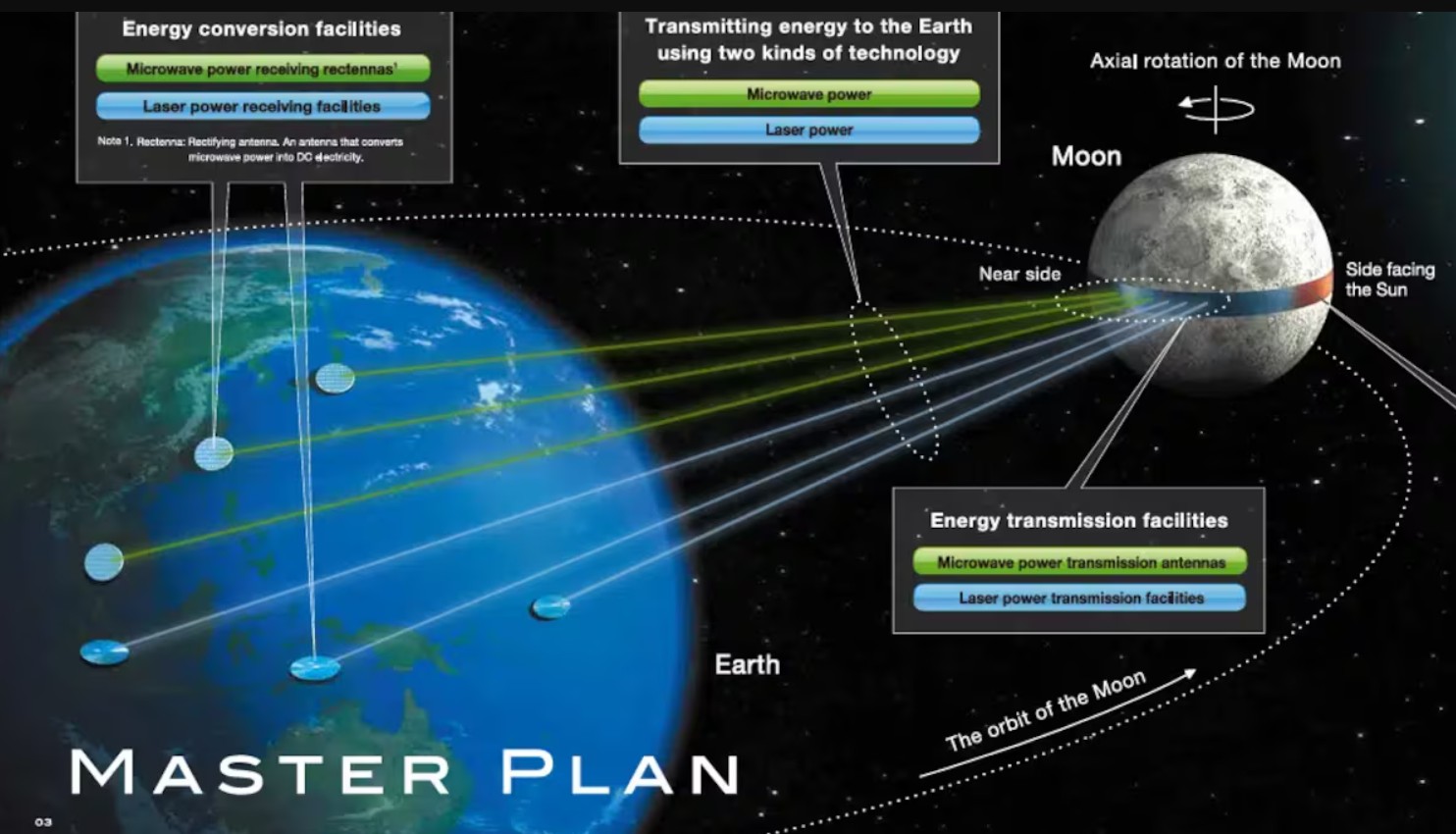
The plan is to create an energy system in orbit around the Moon that can continuously capture solar radiation and “beam” down to Earth.
Japan wants to build a solar ring around the Moon for infinite energy
Fifteen years ago, the Japanese construction company Shimizu Corp put forward an idea that to many sounded like pure science fiction: a huge belt of solar panels around the moon’s equator.
The project, which has been named Luna Ring, would span over 11,000 kilometers and enable uninterrupted production of solar energy – without being dependent on weather or darkness.
When the initiative was first launched, it received little attention. But after the Fukushima Daiichi nuclear disaster in March 2011, Japan’s interest in alternative energy sources increased dramatically.
“A twentieth of the energy on Earth”
The company behind it, Shimizu Corporation, claims that solar panels on Earth generate only one-twentieth of the energy a similar system would produce in space. At the lunar equator, there is no atmosphere, clouds or night – which provides uninterrupted access to sunlight.
Tetsuji Yoshida, the company’s president, stated that if all this energy could be sent back to Earth, it would no longer be necessary to burn coal, oil or biomass.
Solving the main problem of solar energy on Earth
This project would solve one of the biggest challenges of terrestrial solar energy: irregular access. On Earth, solar power plants stop producing electricity at night, and clouds dramatically reduce efficiency. On the Moon, that would not happen.
The idea is to capture solar energy on the Moon via panels placed at the equator, convert it into electricity and transport it to the side of the Moon facing Earth. From there, the energy would be converted into lasers, sent to Earth, and eventually turned into usable electricity.
Can also produce hydrogen as fuel
According to Shimizu’s proposal, the system can also produce hydrogen for use as fuel – an important step towards a society that is less dependent on fossil fuels.
The actual construction of the project will be carried out by robots controlled from Earth around the clock, with occasional help from a small group of astronauts.
The big challenge: The costs
The biggest obstacle, however, is the astronomical cost. Masanori Komori, an economist at Japan’s Institute of Energy Economics, says that the idea is attractive in theory – but far too expensive to become reality.
That’s why we’re mixing sports, streaming and interactive entertainment more than ever