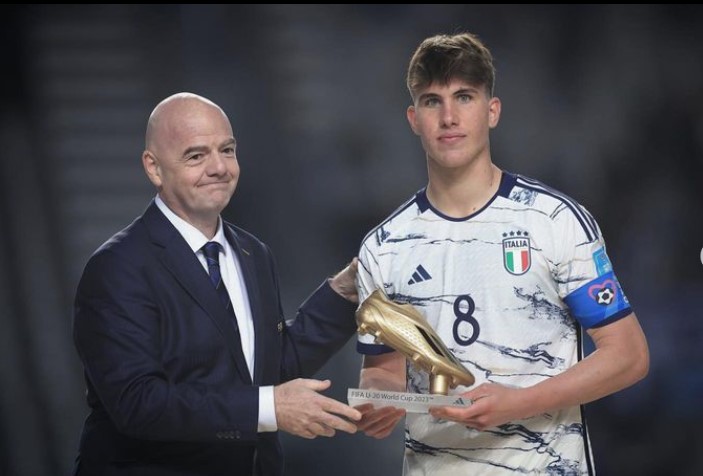
Being president of FIFA is not a cushion for rest. It gives enormous power – and usually at least as much noise. Gianni Infantino has been served both in plentiful quantities.
The road from a law firm in Switzerland to the top of the world’s most powerful football organization has been steep, fast and far from dust-free. With nine medals of honor from nine different countries – including Russia – he has amassed both friends and enemies along the way.
Read: Tottenham bid €55 million plus bonuses for Andreas Schjelderup
With the 2026 World Cup now delivering the goods on the pitch, the spotlight outside has never been stronger. Infantino himself, and every decision he makes, is more exposed than ever.
With his recent statements, political alliances, and the growing opposition to his vision for FIFA, we’ve delved into the career of the man who keeps dividing the waters.
Childhood and background
Gianni Infantino was born on March 23, 1970 as Giovanni Vincenzo Infantino. He has dual citizenship – Switzerland and Italy – and grew up as an Inter Milan supporter. From an early age, he showed himself to be a gifted linguist; Today, he is fluent in seven languages. A quality that would prove to be invaluable in the encounter with European football.
After law school, he started as a legal advisor and general secretary at the International Centre for Sports Studies in Neuchâtel, before gradually working his way into the corridors of FIFA.
The road to the top
The journey into UEFA’s inner life started in 2000, when he started working in the organization’s legal and commercial departments at the age of 30. He quickly climbed the ranks, and in 2004 he became Director of Legal Affairs and Club Licensing.
In 2007, he took the step up to deputy secretary-general, before being promoted to secretary-general two years later – just below the then powerful president Michel Platini.
For many, Infantino is primarily known from Champions League draws and other TV appearances. But his influence went far deeper. He was instrumental in the introduction of key measures such as Financial Fair Play, the extension of the European Championship to 2024, and the start of the Nations League. It earned him a strong reputation as someone who left his mark on football’s development.
The FIFA president who took over after the scandal
After years behind the scenes, there was only one step left. In 2015, he took over as FIFA president from Sepp Blatter, whose regime collapsed under the weight of corruption scandals. Infantino filled the power vacuum and was officially elected the following year.
Since then, he has been re-elected in 2019 and 2023, and is speculated to run for another term in 2027. But his time as president has not only been marked by triumphs. Criticism has hailed – including from icons such as Diego Maradona, who retired from a FIFA legend role in 2019 and stated that he was treated “like a dog” by Infantino. Maradona also compared Infantino’s regime to Blatter’s, claiming that nothing had changed.
New ideas and controversies
Infantino’s next big-scale idea? To expand the World Cup in 2030 to 64 teams. Another gigantic increase, having already gone from 32 to 48 teams. More fights, more money, more drama – and more opportunities for advertising. This summer, he also introduced “drinking breaks”, which were met with loud whistling from the stands throughout the championship.
The friendship with Trump – and other political ties
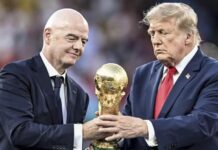
One of the biggest talking points during the 2026 World Cup has been Infantino’s relationship with political leaders – especially US President Donald Trump. The world looked stunned when Infantino presented Trump with the first “FIFA Peace Prize” in December 2025.
During the championship, USA’s star player Folarin Balogun was sent off and risked missing the quarter-finals against Belgium. But when Trump went out and claimed that Balogun should not have received a red card, FIFA quickly reversed the decision – and Balogun was able to play.
Now Infantino is receiving criticism from the International Olympic Committee (IOC), which has filed a complaint against him for violating rules of political neutrality in his meeting with Trump. The European Parliament has also registered its concern.
As if that wasn’t enough, he has also been criticized for having “helped” Argentina to the final. After the victory over Cape Verde, he stated: “Tonight I suffered with Argentina… But I am neutral.” – a comment that raised eyebrows all over the football world.
Battle for re-election
Recent developments suggest that Infantino’s presidency may be in jeopardy. UEFA is said to have backed an opposing candidate in the next election, despite the fact that Infantino himself wants to run unopposed. The German Football Association is said to have refused to sign a letter supporting Infantino for a second term.
The cases are starting to pile up, and the opposition among key players in UEFA and other football leaders is growing. Infantino now faces perhaps the toughest battle of his career – the battle to retain power in FIFA.