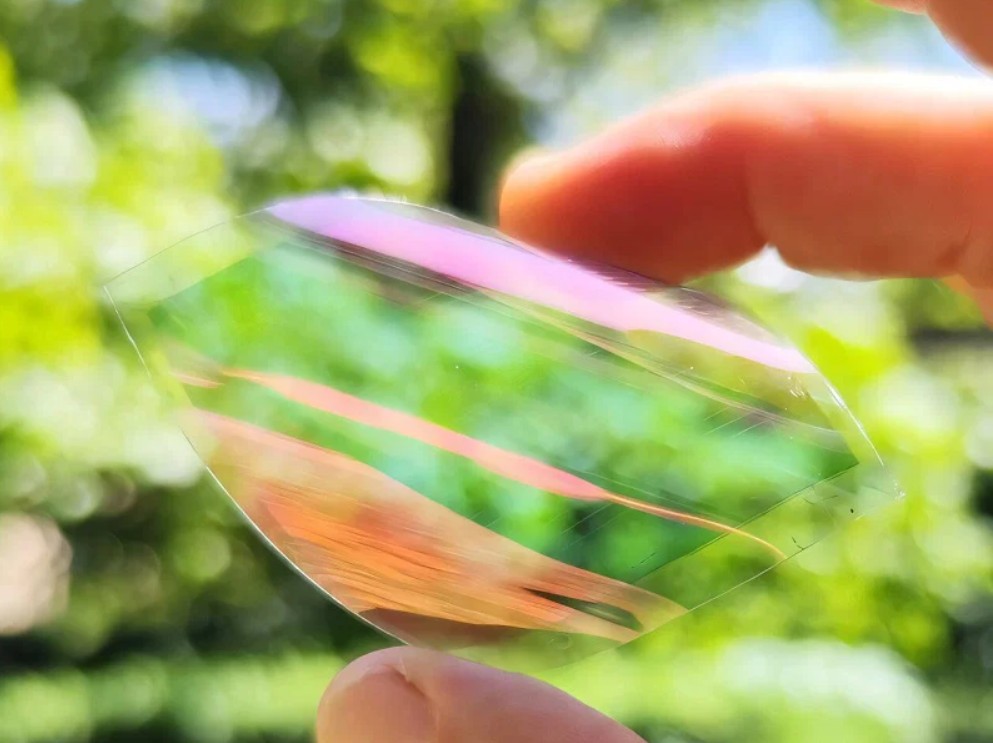
Imagine that your windows produce electricity – while you can see right through them. Now the researchers are a big step closer to reality.
Researchers in Germany have developed larger, semi-transparent organic solar cell modules – with production methods that can be scaled up to industrial production.
Read: Diego Maradona’s “Hand of God” ball sold for millions at auction
At the University of Freiburg and the Fraunhofer Institute for Solar Energy Systems ISE, they have created organic solar modules measuring 14.5 x 14.5 centimeters. The panels let an average of 43.2 percent of visible light through, while converting sunlight into electricity with an efficiency of up to 9.26 percent. The results have been published in the journal Joule.
Organic solar cells – a completely different type of technology
Organic solar cells differ radically from the traditional silicon panels we often see on roofs. The light-absorbing materials consist mainly of carbon-containing compounds – and can be made thin, light and flexible. They can also be engineered to let through specific wavelengths of light.
This makes them particularly attractive where ordinary, opaque solar cells are not suitable – such as windows, glass facades, greenhouses and car roofs.
From laboratory to large-scale
One of the biggest challenges has been to transfer promising laboratory experiments to commercial products in a larger format. Small experimental cells are often carefully made by hand under strictly controlled conditions. Producing the same technology over large surfaces – without losing performance – is far more difficult.
Now the German researchers have solved the problem by using two established production methods: sputtering and slot-die coating.
Slot-die coating distributes thin, controlled layers of material evenly across a surface, and can be adapted to large-scale production. The researchers succeeded in applying the method to all solar cell layers – without any significant loss of performance during scaling.
The modules contain more than 100 individual solar cells, interconnected using precise laser technology. Each cell has a rear electrode that reflects near-infrared light, an organic semiconductor layer that absorbs light, and a transparent top electrode. The top electrode is made of the conductive polymer PEDOT:PSS – not metal. A newly developed version of this material has improved the transparency of the modules.
The trade-off: light transmission vs. electricity production
There is still an inevitable trade-off with transparent solar technology: the more sunlight that is let through, the less light is available for electricity generation.
Nevertheless, the researchers believe that they can now improve transparency further without significantly reducing efficiency. Organic solar modules that let through more than half of the visible light can potentially replace ordinary glass in windows and greenhouses.
Lower transparency can also be useful where tinted glass surfaces are already desirable – such as car roofs or some building facades.
Flexible solar cells – and the way forward
The technology may eventually become flexible. The researchers have already produced early organic solar modules on flexible film – using methods that are compatible with continuous roll-to-roll production. In testing, the flexible modules retained 100 percent of their original efficiency after being bent 1274 times around a rod of only 15 millimeters in diameter.
The next challenge: to make these flexible modules significantly larger.
If the researchers succeed in scaling up the technology – while maintaining performance and durability – the buildings of the future can use large areas of windows and glass facades for two purposes at the same time: let in daylight – and quietly produce renewable electricity.
Health manager: Belly fat and low vitamin D can be a dangerous combination