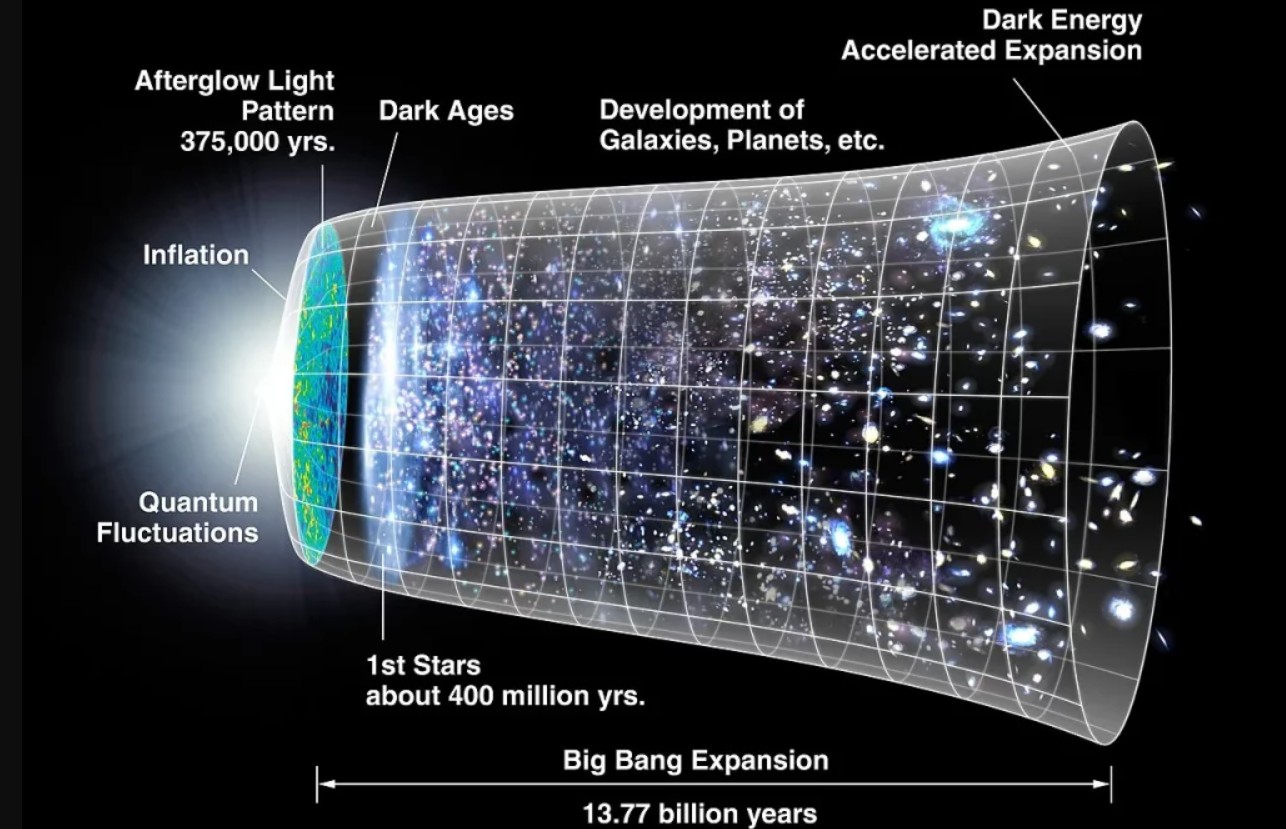
About five billion years ago, dark energy gained a foothold. Since then, the expansion of the universe has not only continued – it has accelerated.
Here comes perhaps the scariest sentence in all of science: The universe is expanding faster and faster.
Read: The border library between the US and Canada loses the common entrance
Every galaxy is moving away from all other galaxies. The further away, the faster it goes. And worst of all: Acceleration increases.
Whatever it is that drives this – we call it dark energy, mostly because we have no idea what it really is – it seems to win.
This has been established science since 1998. At that time, scientists looked at exploding stars — type Ia supernovae — and made one of the most sensational discoveries in the history of astronomy.
In 2011, the team behind received the Nobel Prize in Physics. The accelerating universe became a mainstay of modern cosmology.
Then, in November last year, a study from South Korean scientists came out that threatened to tear the entire pillar loose.
According to their analysis of the same supernovae, the universe had actually begun to slow down. The dark energy was weakening.
If this was true, the cosmologists would have to start all over again. The fate of the universe? It would have been completely different than we thought.
The astronomical community reacted with a mixture of “wow” and “wait a minute”. Extraordinary claims require extraordinary evidence.
The investigation took time, but now it is here.
An international team of astrophysicists – including Adam Riess and Brian Schmidt, two of the 2011 Nobel Prize winners – has published a devastating response in the Monthly Notices of the Royal Astronomical Society.
The conclusion is crystal clear:
The expansion of the universe is still accelerating. Dark energy is still on the scene.
The South Korean study contained a significant error.
The mistake? How they estimated the age of the stars that exploded.
The Korean study assumed that the age of a supernova star was the same as the age of the galaxy in which it lived.
Sounds reasonable, but it’s not correct. Stars in the same galaxy are born at very different times.
That error distorts the brightness calculations – and when the brightness is wrong, the conclusions about the expansion of the universe are also wrong.
In addition, the Korean paper had not adjusted for the mass of the host galaxies – a completely standard correction in modern cosmology.
When both errors are corrected, the evidence for cosmic acceleration is as pure and clear as before.
What’s almost refreshing about this episode is what it says about how science actually works:
Someone made a bold claim. It was taken seriously. Independent experts tested it thoroughly. And errors were found.
Not because of ideology or defensiveness, but because the data – when processed correctly – tells a different story.
The mystery of dark energy is as deep as ever. We know that it exists. We know that it accelerates the expansion of the universe.
But we still have no idea what it really is.
The difference now? We can go back to trying to answer that question – instead of wondering if the whole question was wrong.
Read on The Health Manager: These very common foods can help the elderly stay strong for longer