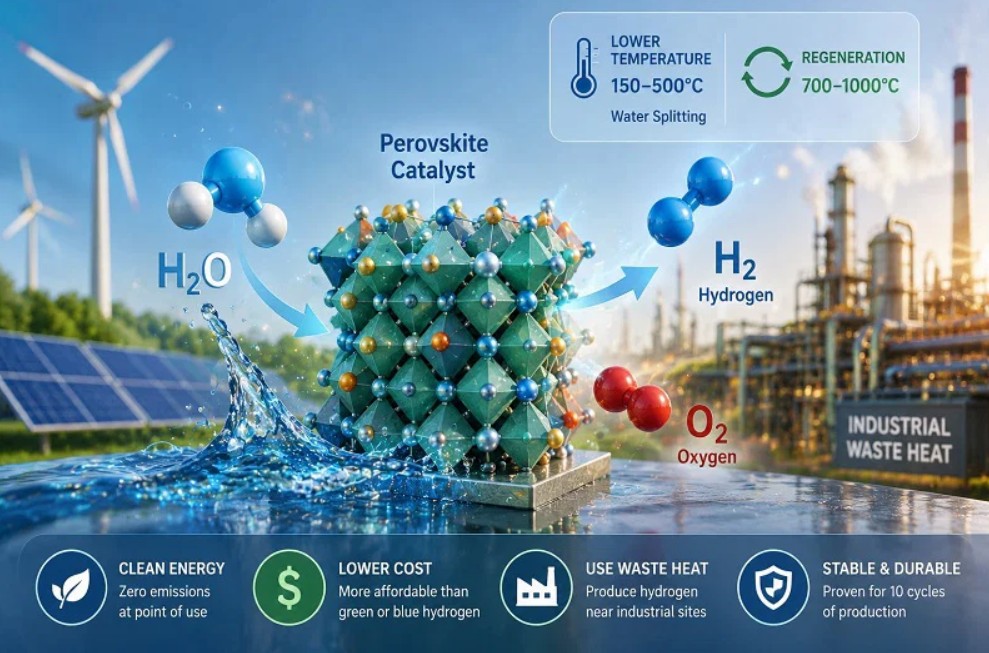
Can provide clean hydrogen at a far lower price
Researchers at the University of Birmingham have developed a new method for producing hydrogen that works at far lower temperatures than current technologies.
The breakthrough could make clean hydrogen cheaper to produce and make it possible for factories to make hydrogen using waste heat that would otherwise just disappear.
Read: Why carbon dioxide cools the upper atmosphere – while warming the earth below
The study, published in the International Journal of Hydrogen Energy, focuses on a special material called a perovskite catalyst. This catalyst can split water into hydrogen and oxygen far more efficiently than current thermochemical methods.
Why we need cleaner hydrogen
Hydrogen is considered one of the most promising clean fuels for the future, because it only produces water and heat when it is used.
It can also power fuel cells that generate electricity without emitting a single drop of carbon dioxide.
Nevertheless, most hydrogen today is still produced from fossil fuels such as natural gas – which creates large greenhouse gas emissions.
Scientists have been looking for cleaner ways to make hydrogen for years. One promising method is thermochemical water splitting, where heat and catalysts are used to separate water into hydrogen and oxygen.
The problem is that today’s systems require extremely high temperatures – often between 700 and 1000 degrees Celsius for the water splitting itself, and up to 1300-1500 degrees to regenerate the catalyst so that it can be used again. These temperatures make the process both expensive and energy-intensive.
The breakthrough: a catalyst that can withstand lower temperatures
The research team in Birmingham, led by Professor Yulong Ding, found a way to dramatically lower these temperatures. The solution was a specially designed perovskite catalyst made of barium, niobium, calcium and iron.
These materials are relatively common, non-toxic and easier to produce than many advanced catalysts.
The researchers discovered that the new catalyst could produce significant amounts of hydrogen at temperatures as low as 150–500 degrees Celsius. The catalyst can also be regenerated at temperatures between 700 and 1000 degrees – around 500 degrees lower than many current technologies require.
Waste heat from industry can become a resource
Lower temperatures open up great practical benefits. Many heavy industries – such as steel mills, cement factories, glass production and the chemical industry – produce enormous amounts of waste heat during normal operations.
According to the researchers, this waste heat can potentially be used to drive hydrogen production right then and there.
Producing hydrogen close to where it will be used also reduces the need for costly transport and storage infrastructure – still one of the biggest barriers to large-scale use of hydrogen.
Could be cheaper than both green and blue hydrogen
The team has also done an early economic analysis of the technology. The results suggest that the new process can produce hydrogen at a lower cost than both green hydrogen (made with electrolysis powered by renewable electricity) and blue hydrogen (made from natural gas with carbon capture).
The cost advantage can be especially important in countries that have abundant renewable energy and low electricity prices – such as Australia.
Patent pending and ready for commercialization
The research was done in collaboration with the University of Science and Technology Beijing. The University of Birmingham has already filed a patent application for the technology and is now looking for commercial partners to further develop it.
The researchers say that the new catalyst remained stable for at least 10 production cycles, with little visible structural damage during testing. They believe the technology can be an important step towards cleaner and cheaper hydrogen production in the future.
Read on Sporten: Manchester United have everything to gain from Lewandowski signing