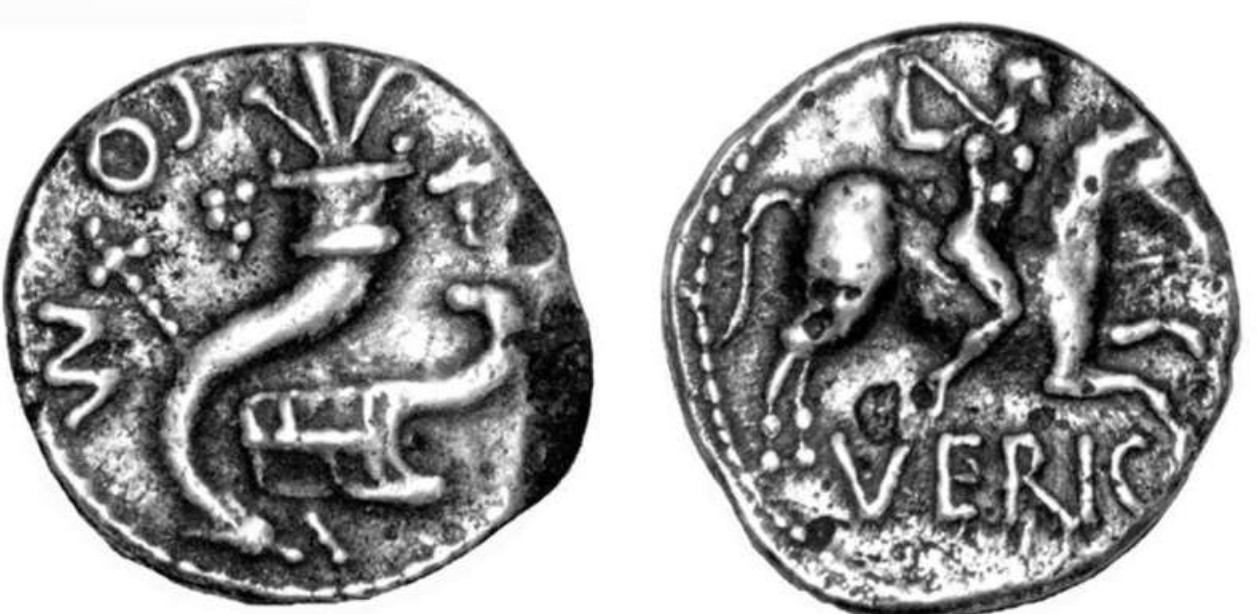
Antique coins reveal surprising gender:
A powerful ruler associated with Rome’s invasion of Britain may have been a woman – not the man described in many historical accounts. New interpretations of ancient coins and written sources challenge the well-known identity of Verica.
A new interpretation of ancient coins and written sources questions the gender of Verica, a powerful figure in late Iron Age Britain. The argument is important because Verica’s appeal to the Roman Emperor Claudius helped shape the events surrounding the invasion in 43 e.Kr. Rethinking this ruler could change how historians understand women’s political influence at a crucial moment in Britain’s past.
Read: Google ads crush ChatGPT: – 6.6 times more revenue per ad dollar
Miles Russell, an archaeologist at Bournemouth University, presents the research in the forthcoming book Caratacus: Great King of Britain. The interpretation is also discussed in Current Archaeology and builds on a new reading of existing evidence – not newly identified human remains.
Escape to Rome – and an invasion
Verica ruled Atrebates, whose territory included much of present-day Hampshire and West Sussex. After being driven from power around 40 e.Kr, Verica fled to Rome and sought support from Claudius.
The Roman historian Cassius Dio linked this appeal to the decision to invade Britain. Russell argues that Verica should therefore be understood as an important political participant – rather than a minor figure who briefly appeared before the Roman conquest.
The name, image, and title
Part of the argument concerns the ruler’s name. Russell points to the name’s ending as consistent with the names of female leaders of the period, including Boudica and Cartimandua – while challenging assumptions inherited from earlier historians.
Another part concerns coin images. Russell interprets a slender, bare-chested figure on horseback carrying a spear as a woman – and contrasts it with more obvious male warriors depicted by other coin-producing rulers.
He also disputes the assumption that the Latin title rex on the coins necessarily establishes that Verica was male. These interpretations form part of his overall case: title and image should not be treated as separate, definitive tests of the ruler’s gender.
Roman literary conventions
Russell further considers how Roman writers portrayed Claudius as susceptible to the influence of women and the emancipated. He suggests that the account of Verica’s persuasion can be read against these literary conventions – rather than being taken as a politically neutral description.
In this interpretation, Verica brought useful knowledge and support to Rome’s campaign, while also seeking a return to power. The relationship would have involved political interests on both sides, with Claudius being given an opportunity for a military triumph.
Still a historical interpretation
The claim remains a historical interpretation that requires consideration along with complete coin evidence, language, and ancient texts. The report does not provide genetic confirmation or show that all scientists accept the proposed identification.
Its contribution is to reopen an issue that has often been treated as settled. Looking at familiar artifacts again can reveal how assumptions about who might be in power have shaped the stories of Iron Age Britain and its relationship with Rome.
For broader related reading, see articles on Ancient Rubbish Heaps Revealing the Secret Social Life of Bronze Age Britons, and Ancient Murals at Teotihuacan May Reveal the Language of a Lost Civilization. For more information, see articles on Archaeologists Undiscover 138 Ancient Tools That Rewrite Europe’s Prehistory, and Ancient Flower Art Reveals Mathematical Thinking for 8,000 Years Ago.
Manchester United can’t afford to make a mistake with captain Bruno Fernandes