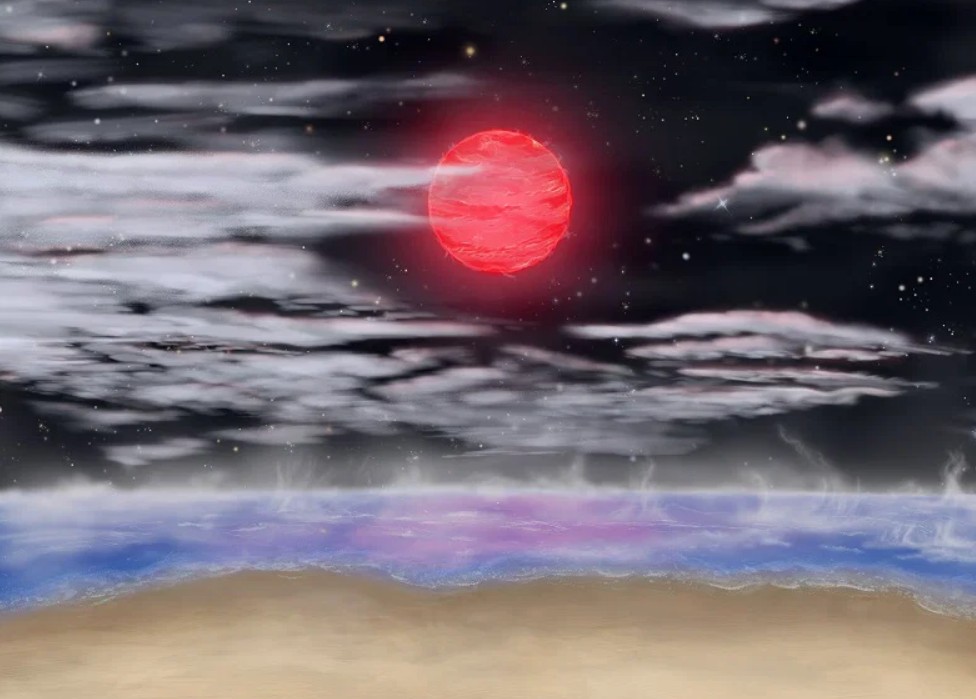
The planet has a minimum mass that is just over twice that of Earth, and orbits its star at a distance that gives it almost as much starlight as we get from the Sun. It belongs to an ever-growing group of potential life hosts in our near-cosmic vicinity.
One of our closest planetary neighbours may turn out to be far more Earth-like than scientists first assumed – and thus far more promising in the search for life outside our own world.
Astronomers have taken a new, more detailed look at the exoplanet GJ 3378b — a world that lies outside our own Solar System — and discovered that it is probably both smaller and rockier than previous calculations indicated. This makes it a significantly more interesting candidate in humanity’s age-old question: Are we alone in the universe?
Read: MacKenzie Scott has donated over $26 billion – now Elon Musk is attacking her
The findings, recently published in The Astrophysical Journal, strengthen the hope that this distant planet may have the right conditions for life.
25 light-years away – and still within reach
GJ 3378b is located about 25 light-years from Earth, in the direction of the constellation of Camelopardalis (The Giraffe). For us humans, it’s an unimaginable distance, but on a galactic scale, it’s almost the neighboring genre – a stone’s throw away in our part of the Milky Way.
The planet orbits a small, cool red dwarf star. Such stars are far smaller and fainter than our own Sun, but they are also the most common type of star in the Universe — in fact, red dwarfs make up about 70 percent of all stars in the galaxy. Therefore, they are being targeted as astronomers search for planets that could harbor life.
What has really attracted attention about GJ 3378b is that it is located in the star’s habitable zone — the “gold-lock distance” where the temperature is just right for liquid water to be found on its surface. And water, as we all know, is the most important ingredient in life – at least as we know it.
New measurement – new insight
To uncover the planet’s secrets, the researchers used the Habitable-zone Planet Finder — a highly sensitive instrument connected to the Hobby-Eberly telescope at the McDonald Observatory in Texas. The instrument does not look directly at the planet, but instead measures the microscopic motions of the star when the planet’s gravity causes it to “wobble” in orbit.
And this is where the surprise came:
When GJ 3378b was discovered in 2024, it was assumed to have about five times the mass of the Earth. The new measurements show that it in reality weighs only about 2.3 Earth masses.
It’s a game-changer.
Lighter super-Earths are far more likely to be rocky planets – solid planets with surfaces you can walk on – rather than gas giants with thick, crushing atmospheres. And a rocky surface provides completely different opportunities for liquid water and potential life.
At the same time, the researchers found that the planet completes one orbit around its star in 21 days, not 25 as previously thought. Although it sounds staggeringly close, we have to remember that the star is much cooler than the Sun — so the planet still stays safely within the habitable zone.
But – an important caveat
However, the researchers urge caution. Orbiting so close to a red dwarf can be a challenge: stars of this type are notorious for emitting powerful bursts of radiation that, over time, can strip a planet of its atmosphere. And without an atmosphere – no protection, no liquid water, no life as we know it.
The telescopes of the future may provide the answer
But hope is alive. Next-generation giant telescopes — such as the Giant Magellan Telescope, the Extremely Large Telescope and NASA’s planned Habitable Worlds Observatory — will be able to study GJ 3378b in far greater detail than ever before. Scientists hope that these eyes on the sky can one day pick up biosignatures – chemical traces in the atmosphere that can reveal the existence of life.
Until then, GJ 3378b is one of the most exciting nearby worlds we know. Not because we know that there is life there – but because the new findings suggest that it may be a far better place to look than we first thought.
Source: University of Texas at Austin
Read on Sporten: Eirik Horneland is back where he has actually succeeded before