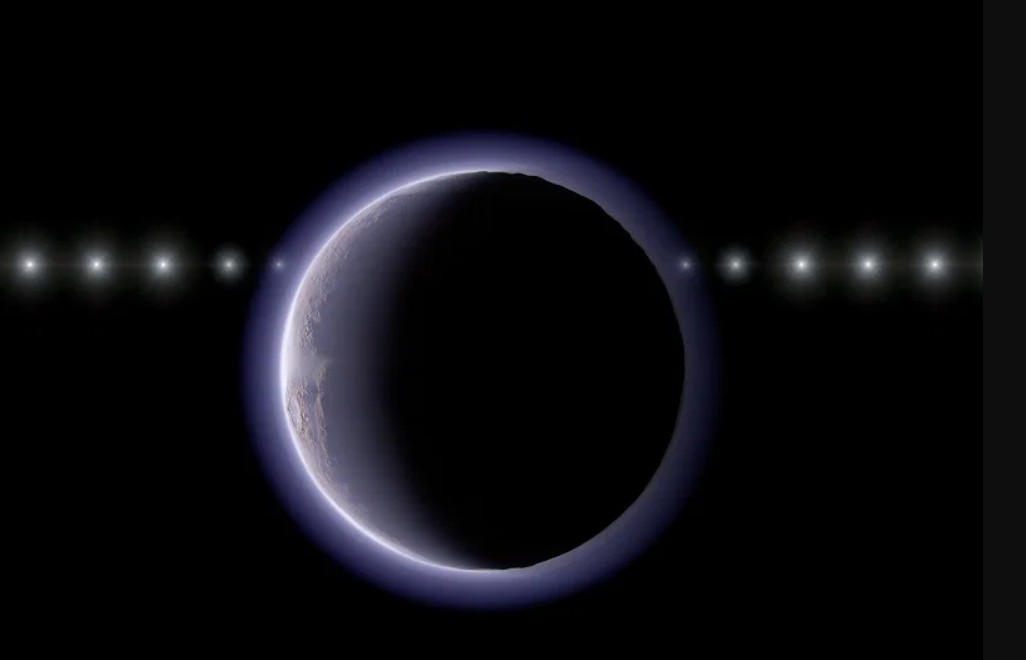
Far beyond Neptune, in one of the coldest and darkest regions of our solar system, astronomers have made a completely unexpected discovery: a small icy object with an atmosphere that really shouldn’t be there.
The object, known as 2002 XV93, belongs to a group of distant celestial bodies called trans-Neptunian objects (TNOs). These orbit the Sun at very great distances and are usually extremely cold – with weak gravity.
Read: Peter Capaldi and Cush Jumbo talk about the second season of “Criminal Record”
Therefore, scientists believe that the vast majority of TNOs cannot hold an atmosphere. Even Pluto, the most famous of them, has only a very thin atmosphere.
Smaller than Pluto – but with surprising gases
The 2002 XV93 is much smaller than Pluto – about 500 kilometers in diameter, compared to Pluto’s 2,377 kilometers. Both its size and conditions would indicate that it cannot possibly hold gas around it. Nevertheless, new observations suggest that it has an atmosphere.
The discovery was made by a team of professional and amateur astronomers in Japan. They took advantage of a rare event on January 10, 2024, when 2002 XV93 passed right in front of a distant star as seen from Earth – a so-called occultation.
The light didn’t suddenly disappear – it faded
By paying close attention to how the starlight changed, scientists were able to learn more about the object. If the 2002 XV93 had no atmosphere, the light would have disappeared immediately when the object blocked it.
But instead , the light gradually faded — a clear sign that the jets passed through a thin layer of gas before being blocked. Therefore, the researchers believe that there is an atmosphere.
The findings were led by Ko Arimatsu at the NAOJ Ishigakijima Astronomical Observatory and published in the renowned journal Nature Astronomy.
“An atmosphere that is about to disappear”
The calculations show that the atmosphere around the 2002 XV93 is extremely thin and probably temporary. In fact, it can only last for less than 1,000 years – unless it is constantly replenished. This raises a new mystery: Where does the gas come from?
Observations from the James Webb Space Telescope show no clear signs of frozen gas on the surface that can turn into gas and form atmosphere.
Possible explanations: Internal emissions or comet impacts
The researchers have proposed two possible scenarios:
- Internal gas emissions: It could be that gases deep inside the object reach the surface and are released into space.
- Comet impact: A recent collision with a comet may have released gas and created a short-lived atmosphere.
So far, no one knows for sure. Further observations will be required to crack the code.
But one thing is already clear: even the smallest and most distant worlds in our solar system can still surprise us.
Read on The Health Manager: What exercise actually helps you sleep better? New study provides the answer