As the reigning champions secured the group victory, fans turned their attention to the knockout bracket – and what they saw sparked the debate. Lionel Messi’s team seemed to avoid all of the tournament’s biggest challengers right up until the final rounds.
The seemingly easy path has sparked massive claims that FIFA has once again facilitated Argentina. Others insist that the bracket only mirrors the results achieved on the pitch. With statistics, tournament format and passionate fan reactions at play, the debate has become almost as intense as football itself.
Mikel Merino! Spain’s unlikely World Cup hero who survived e-scooter injury
Perfect group stage – and a surprising way forward
Argentina finished the group stage with a perfect record: three wins, nine points, eight goals scored and only one conceded. With a goal difference of +7, they were one of the strongest teams in the tournament.
The reward for winning Group J? A round of 32 against World Cup newcomer Cape Verde. After that, Australia or Iran are likely to await in the round of eight, before a possible quarter-final against Croatia, Colombia, Switzerland or Algeria.
On paper, this is a far easier path than on the other side of the draw, where Spain, France, Germany, Portugal, Brazil, England and Belgium can knock each other out even before the semi-finals. Contrast quickly became one of the most discussed topics in social media.
No one in FIFA’s top 15 so far in the tournament for Argentina. Switzerland, which after winning its round of 16 is in 14th place in the ranking (19th place just over a week ago), is the one with the highest ranking.
How did Argentina end up with this bracket?
Many claim that FIFA has deliberately given Argentina an easy path. But the structure of the knockout round was set long before the tournament started. The teams earned their spots based solely on the group stage. Argentina could only control one thing: winning the group. They did.
The rest of the bracket changed because several favorites failed. Uruguay lost points, Portugal disappointed, Belgium fell, and Spain was surprisingly held to a draw by Cape Verde. These results changed the knockout picture dramatically. Instead of facing traditional greats early on, Argentina now faces teams many consider less intimidating on paper.
Cape Verde – the smallest surprise in history
The biggest surprise is without a doubt Cape Verde. The African nation with just over half a million inhabitants is one of the smallest countries ever to reach the knockout stages of a World Cup. They managed the feat without winning a single group game.
They held Spain to a 0-0 draw, drew 2-2 with Uruguay and shared the points with Saudi Arabia. Disciplined defence and brilliant goalkeeping earned them a historic place in the round of 32.
Ironically, their adventurous journey has become one of the main reasons for the conspiracy theories surrounding Argentina’s road. Instead of facing Spain or Uruguay, the reigning champions now face one of the tournament’s biggest underdog stories.
Social media is exploding – again
As soon as the bracket became known, social media exploded. “FIFA is once again rigging for Messi”, “this is written in advance” and “set up for Argentina” were among the comments that went viral.
One of the most shared posts read: “FIFA continues to give Argentina easy opponents. Corruption lives on.” Another claimed, “This bracket was designed for Messi.”
Argentina’s supporters rejected the accusations. They pointed out that the bracket only looks favorable because several of the big nations failed to win their groups. One of the most popular responses was: “People blame FIFA because Spain and Uruguay failed to beat Cape Verde.” Another joked: “Messi has really traumatized people.”
48 teams – more unpredictable than ever
The 2026 World Cup is the first with 48 teams – an expansion from 32. While FIFA introduced the format to give more nations the opportunity to participate, it has also created greater unpredictability in the knockout stages.
With more teams advancing, the chance of traditional greats stumbling increases, while new nations benefit from favorable outcomes. That is exactly what happened this year.
Cape Verde is not the only surprise team. Several established football nations lost important points, while teams many predicted would go out early, suddenly were left with knockout places.
Football analysts have long pointed out that an extended championship naturally increases variation. More layers mean more chance of unexpected results – and it can change the whole bracket without any outsiders interfering.
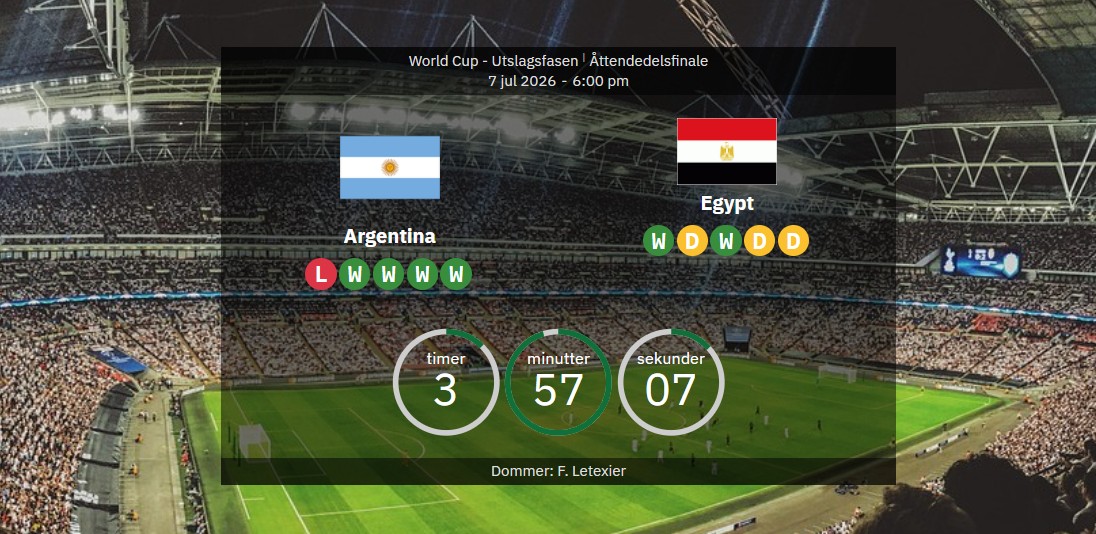
Argentina’s victory over Egypt with highly questionable decisions by both referees and VAR has sparked an investigation and FIFA admissions of fouls have further sparked debate.
Two camps – continued division
The discussion has revealed a clear divide among football supporters. Those who question the bracket believe Argentina have been lucky with results elsewhere in the tournament. Some argue that avoiding more European giants until later rounds increases the chances of Argentina defending their title.
Others see no controversy at all. They point out that all teams had the same opportunity to win their group – and those who didn’t have themselves to blame.
Many also emphasize that it can be dangerous to underestimate teams like Cape Verde, Australia or Iran. The World Cup has shown time and time again that knockout football often ignores rankings and predictions. Favorites regularly fall for certain underdogs.
If Argentina wins the World Cup, it will unfortunately be with a bad taste in the mouth.
The poisoning of the World Cup – the American way