Researchers at the Institute of Science and Technology Austria (ISTA) have developed two new computer graphics techniques that can make video games, animated films and digital simulations far more realistic – while drastically reducing the computing power required.
The two studies, presented at the SIGGRAPH conference in Los Angeles and published in ACM Transactions on Graphics, address long-standing challenges in computer graphics.
Read on Radiosporten: Fantastic Antonio Nusa referred to as “the saviour” for Champions League club
One technique improves how highly flexible surfaces are textured during animation. The second speeds up calculations that help computers understand the shape of 3D objects.
Nature as a model for realistic surfaces
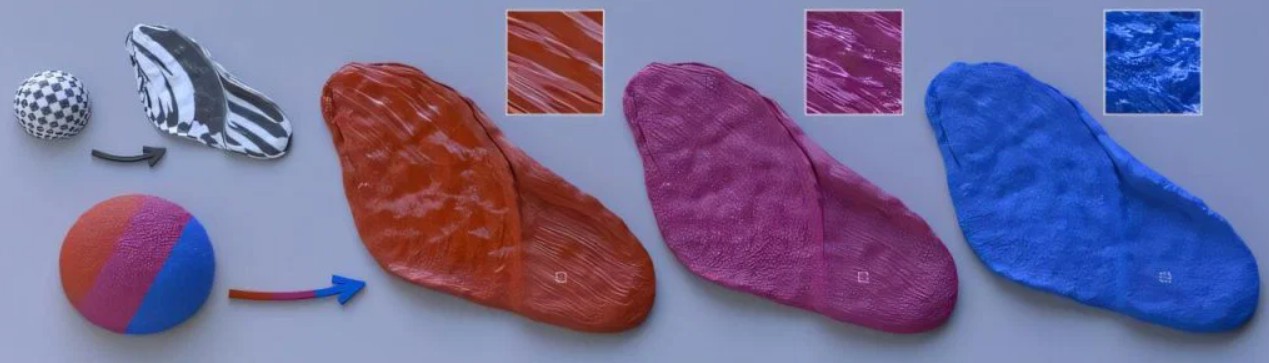
One of the biggest challenges in computer graphics is making soft, highly deformable objects look natural.
Materials such as cookie dough, lava, slime or fabric stretch, compress and change shape constantly. As objects move, surface details can blur or flicker — making computer animations appear less realistic.
PhD student Aleksei Kalinov and colleagues in Professor Chris Wojtan’s research group were inspired by nature.
They observed that when natural materials are stretched, the surface patterns don’t just disappear. Instead, fine details gradually transition into larger, smoother structures. When the material returns to its original shape, many of the subtleties automatically reappear.
With these insights, the team developed an entirely new way of describing textures – based on physical properties such as size and pattern frequency, rather than individual pixels. This allows the computer to automatically recreate realistic details when an object is stretched or compressed.
The researchers created two new algorithms to make this happen. One restores fine surface details after stretching, while the other preserves the original look by resisting unwanted distortion. Since both methods generate the textures automatically, they don’t require complicated physics simulations or storing previous animation data – making them far faster and more efficient.
The team believes the techniques can enhance visual effects, video games, and scientific simulations by producing smoother, flicker-free animations – without requiring powerful hardware.
Ingenious shortcut cuts computing power by 90 percent
In another study, the researchers addressed another important challenge: helping computers quickly determine the shape of complex 3D objects.
When a computer analyzes a digital object, it must determine whether a point is inside or outside the object’s boundaries. This calculation – known as the winding number – is central to many graphics applications, such as animation, physics simulations and 3D modelling.
Traditionally, the more detailed the objects are, the more expensive it is to calculate this, because the computer has to examine large parts of the surface.
PhD student Peiyuan Xie and colleagues developed a far more effective solution.
Professor Wojtan compares the process to a robot vacuum cleaner entering a new room. The robot explores the area to determine if it is enclosed by walls or has an exit. In a similar way, the computer explores the boundaries of a digital form to understand its structure.
Instead of analyzing the entire surface, the new method focuses only on the boundaries where surfaces end or meet. The researchers also introduced a simple form of assistance that temporarily closes open surfaces, allowing the computer to perform far simpler calculations – before the help information is removed and the correct result is left.
This ingenious shortcut reduces the calculation effort by about ten times – while maintaining accuracy.
Together, the two advances show how new mathematical approaches can solve persistent graphics problems – and at the same time make digital content both more realistic and more efficient to produce. The researchers hope the ideas will eventually benefit industries – everything from entertainment and gaming to engineering and scientific visualization.
The World Cup effect: When the football party lifted everything from Vipps to gaming companies