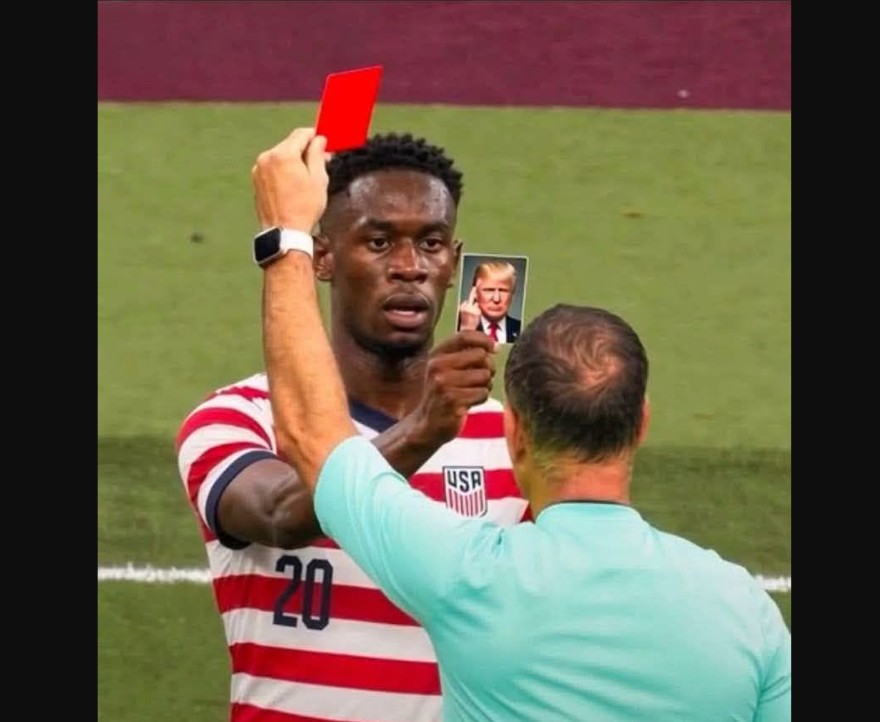
In a surprising decision on Sunday, FIFA annulled Florian Balogun’s one-match ban, allowing the American star striker to play in the round of 16 against Belgium. But Balogun is far from the only one who has seen red in this championship.
According to data from Northeastern University’s NetSI Sport research group, the number of red cards in this year’s World Cup has more than tripled compared to the previous two championships. So far in 2026, 13 red cards have been handed out – compared to only four in both 2018 and 2022.
Read: Premier League club strongly regrets dumping World Cup star Antonio Nusa
What is the difference between yellow and red?
In football, players receive either yellow or red cards for unsportsmanlike conduct. A yellow card is the mildest punishment and serves as an official warning – for illegal tackles, arguing with the referee, simulation or other untimely behaviour.
A red card is far more serious – for serious offenses such as violence, serious criminal tackle, insults, spitting, or deliberately denying an obvious goal chance (DOGSO). Players who receive a red card are immediately sent off – and in the World Cup also suspended from the next match. Two yellows in the same match also give a red.
VAR sends more people on the lookout
Why the sharp increase in red cards? Researchers point to several factors – above all, advances in VAR technology.
Three of the red cards in this year’s World Cup were originally ruled yellow, but upgraded after the referees saw the VAR footage:
- Qatar’s Homam Ahmed – last man foul on Canada’s Tajon Buchanan (June 18)
- Qatar’s Assim Madibo – bone-breaking tackle on Canada’s Ismaël Koné (same fight)
- Iraq’s Rebin Sulaka – DOGSO on Senegal’s Sadio Mané (June 26)
FIFA has also introduced new rules for safe and ethical gaming. Two of the 13 red cards this year were given for violating a brand new rule: players cannot cover their mouths when talking to opponents.
- Miguel Almirón (Paraguay) – vs. Turkey on June 19
- Piero Hincapié (Ecuador) – vs. Mexico on June 30
Over one thing, FIFA has been more generous
While the red cards have skyrocketed, the number of yellow cards and fewer minor offenses has decreased. According to the researchers, FIFA has deliberately tried to let the matches flow more smoothly – without stopping for minor clashes.
One thing is certain: VAR has made the referees more visible – and the players more vulnerable.
Read on Radiosporten: Neymar will never forget Ørjan Nyland