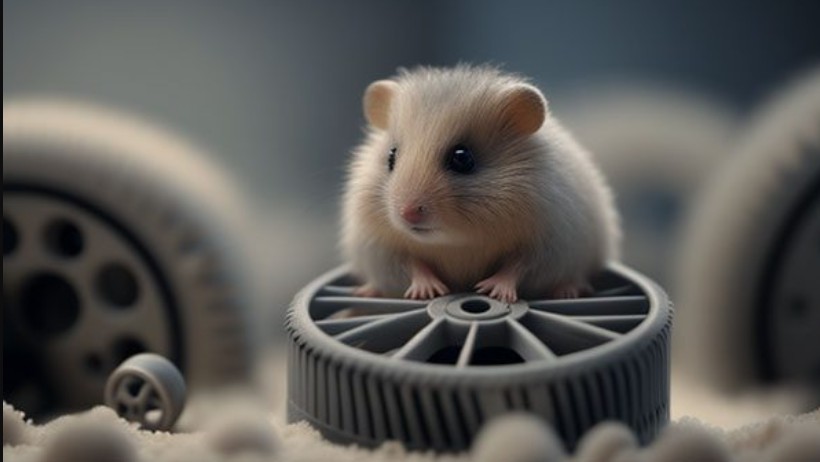
Did you know that some hamsters can inflate their cheeks to float in water? Here, you’ll get to know these adorable mammals better.
Hamsters are cute, furry animals with oversized cheek pouches and short tails. These small rodents live both in the wild and as popular pets. There are about 20 different hamster species, and they thrive in everything from deserts and plains to sand dunes and farmlands across large parts of Europe, Asia and North Africa. One species – the European hamster – is unfortunately critically endangered.
Read: New memory technology can reduce AI energy consumption by more than 60 times
From their elaborate gait systems to their ever-growing incisors, there’s a lot to learn about these little balls of fur. Here are ten things you might not know about hamsters.
Hamsters in a nutshell
- Common name: Hamster
- Scientific name: Cricetinae
- Average lifespan in nature: 2 to 3 years
- Average life expectancy in captivity: 2 to 4 years
- IUCN Red List status: From viable to critically endangered, depending on species
- Current stock: Unknown
1. There are about 20 species of hamsters
Hamsters belong to the Cricetidae family, which also includes field mice, lemmings, rats, and mice. The 20 or so species are surprisingly different – some are more similar to rats, such as the seven members of the genus Cricetulus. The only member of the genus Cricetus – the European or common hamster – on the other hand, has unique black fur on its belly.
The most popular pet species are the golden hamster (also known as the Syrian hamster), as well as three different dwarf hamster species: the winter white dwarf hamster, Campbell’s dwarf hamster, and the Roborovski hamster, which is by far the smallest hamster species of them all.
2. Hamsters are nocturnal animals
Since they’re prey to so many other animals, it’s no wonder that most hamsters are nocturnal. They spend their days hiding from snakes, eagles, foxes, badgers and other predators. In the wild, they dig caves with deep tunnels and multiple entrances – both for protection and for sleeping during periods of hibernation. Hamsters are solitary animals that spend most of their time alone in their burrows. They are also very territorial and will attack other hamsters that venture too close.
3. They are promiscuous
Both male and female hamsters are polygynandy – in other words, they have multiple partners. During the breeding season, males travel from cave to cave and mate with females that have not already mated. Once a female has mated, a mating plug is formed that prevents further fertilization. Hamsters are territorial, and females often kick out the male just after mating.
Females typically give birth to two to four litters a year – the gestation period lasts only 15 to 22 days – and litters can range from one to thirteen cubs, although the average is around five to seven.
4. Hamsters are banned in Hawaii
Due to their high reproduction rate and the fact that Hawaii’s climate resembles the hamster’s natural habitat, these animals are illegal in Hawaii. If they escaped into the wild, they could quickly establish large colonies, which would have become a serious problem for agriculture and the native species on the island. Hawaii’s list of prohibited animals also includes hummingbirds, snakes, gerbils, hermit crabs and salamanders.
5. Their teeth never stop growing
Like all rodents, hamster incisors have no roots, and they never stop growing. By gnawing on things, they keep teeth sharp and at the same time prevent them from becoming too long. Scientists who study rodent teeth have discovered that the incisors contain active stem cells. This property – combined with the fact that teeth are constantly growing out – gives researchers hope that they can one day replicate tooth regeneration in humans.
6. They hoard food
Hamsters are created for food storage. Their cheeks are like little boxes they can fill with fruit, grains, roots and leaves – up to an amount equal to their own body weight. When they find a rich source of food, they fill their cheek pouches and return to the cave, where they have their own food chambers for storage. In fact, their name comes from the German word “hamstern”, which precisely means to collect or store. But the cheeks also have another function: they can be filled with air so that hamsters float in water.
7. They are exposed to bacteria and viruses
Hamsters can carry salmonella, and although rare, they can also be carriers of lymphatic choriomeningitis – a virus that causes flu-like symptoms. The main ways to get infected from hamsters and other rodents are through bites, direct contact with the animal, or indirect contact with objects that are contaminated. Young children and pregnant women are particularly susceptible to such infections.
8. Some hamsters hibernate – in a way
Although most hamsters don’t hibernate in winter, one species does: the golden hamster (also known as the Syrian hamster, which is often kept as a pet). It stays in its burrow, seals its entrance with earth and sleeps in a nest of grass. It wakes up once a week to eat the food it has stored. While in hibernation, its heart rate drops from the normal 400 beats per minute to just four, and it only takes two breaths per minute.
9. Hamsters have poor eyesight
Most hamsters are almost blind in bright light. They see much better in low light, which is why they are nocturnal. Still, they don’t see much further than the tip of their nose. Therefore, they rely on other senses to navigate, especially during the day. They use their highly sensitive whiskers and scent glands on their backs that leave traces that lead them home.
10. European hamsters are critically endangered
The black-bellied European – or common – hamster, which used to be found over large parts of Europe, is now critically endangered. As the only member of the genus Cricetus, both distribution and population have declined sharply in Western, Central and Eastern Europe. The species is no longer found in an estimated 75 percent of its original habitat. Changes in agricultural practices, the development of housing and commercial property, pollution and climate change are the greatest threats.
Read on Popidol: Drake’s new album ‘Iceman’ begins with a deeply personal revelation
Although conservation, monitoring and reintroduction projects in parts of the range have been successful, the decline has occurred rapidly. Conservation plans are needed in all countries where the species is found to prevent it from becoming extinct.
How you can help save the European hamster
- Support initiatives that require EU member states to take action to ensure the species has a favourable conservation status in Europe.
- Support varied farming methods that provide both food and vegetation cover for the hamsters.
- Support changes in infrastructure and private development projects where the hamsters live.
Frequently asked questions
How smart are hamsters?
Previous studies have shown that wild hamsters have good spatial intelligence – including visual memory – when looking for food. Many also believe that they can learn to recognize their name and bond with their people.
Why do hamsters eat their own poop?
Hamsters are coprofage, which means that they eat their own feces to make sure that they are getting all the nutrients from their food. The type of stool they eat is soft – sometimes called “night stool” – and they often eat it straight from the anus.
Do hamsters eat their young?
Hamsters can sometimes kill and eat their young if they feel too stressed to raise them. This is more common among first-time mothers.
Can you release a hamster into the wild?
You should never release a hamster – or any other domestic animal – into the wild, neither for the sake of the animal itself nor the environment. Domesticated animals are not used to hunting for their own food, and they therefore risk starving or dying of thirst. In addition, they can become an invasive species that damages the ecosystem.
Read on The Chief Health Officer: Can positive thoughts reshape the brain? What the research says