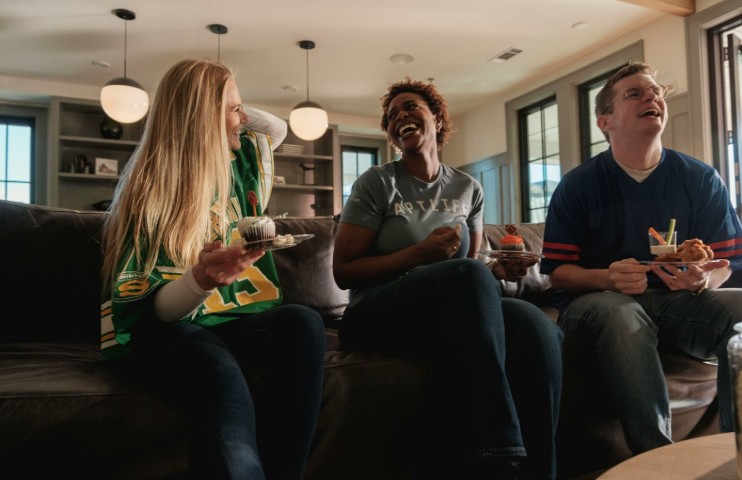
It has become much more difficult to say exactly what people are doing when they are “disconnecting”. Just a few years ago, the answer was often simpler. You watched TV, followed a game, read the newspaper or went to the movies. Today, it looks different. Entertainment is no longer something that happens in clearly defined blocks. It flows between different formats, screens and habits in a way that means that the evening’s entertainment rarely consists of a single thing.
A normal evening can start with reading the news, continue with some sports clips, move on to a series and then end in something more interactive. For many, this feels completely natural. You no longer choose between culture, sports, games or video as if they were separate worlds. You move between them depending on your mood, time and energy.
This is also why broad magazine pages are still perceived as relevant. They not only reflect multiple themes in the same place, but also how people actually use digital entertainment in their everyday lives. You rarely stay in a single category. You alternate.
Media habits are governed more by the situation than by format
Perhaps the most interesting thing about today’s entertainment is that the choice is so rarely about the format itself. It’s more about the situation.
It also means that lighter digital entertainment has taken on a different role than before. It is no longer next to the “usual” offer. It is part of the same cycle as sports, streaming, music and social media. It’s no wonder that someone alternates between a football highlight, a cultural feature and something interactive during the same evening. This is what media use actually looks like in practice.
For many, it’s also about having multiple levels of attention available. Sometimes you want something to really keep an eye on. Other times, you just want something that feels easy to get into without it making so many demands from the start.
Sports, streaming and games no longer live separately
Sport is a clear example of what this development looks like. Before, sports consumption was often about following entire matches from start to finish or reading a longer report the next day. Today, the experience often consists of many smaller parts: clips, highlights, statistics, social reactions, analysis and ongoing updates. Sport is still central entertainment, but the way it is used has changed.
The same applies to many other things. The series you follow is not always the only activity of the evening. The music you listen to is not always the main focus. And the interactive entertainment you use doesn’t have to take over the entire evening to still feel relevant.
This also makes old divisions feel less useful. Anyone who likes sports can also appreciate games. Those who follow culture or film may also wish for something quick and interactive between other activities. Entertainment is no longer one thing at a time. It is complex.
What works best is often what suits the rhythm
It’s easy to think that the most successful content is always the biggest, most expensive, or most advanced. But in everyday life, it often works differently. What returns in people’s evening routines is often what fits the rhythm for the rest of their lives.
If something is quick to get started with, feels familiar and does not require too much start-up, it will more easily have a natural place in the evening. That doesn’t mean that users will have poorer quality. It just means that quality is also about accessibility, flow and feel.
In that perspective, it also becomes natural to see a player like Rocket Riches as part of the same broader entertainment landscape such as video, sports and other digital formats. When people choose what to spend their time doing in the evening, they rarely do it in hard categories. They choose what suits the moment.
Interactivity has become a natural part of Media Day
What has perhaps changed the most is how accustomed people have become to participating in the digital content themselves. We click, react, select, compare, skip on and control our own experience in a way that was less obvious before. This applies to social media, news, streaming and various types of digital entertainment.
Therefore, interactivity no longer feels like a special case. It’s a normal part of how we consume media. For many, it’s just as natural to switch from watching something to doing something themselves as it is to switch between different apps.
It also means that future media use is unlikely to be dominated by a single form. It’s the combination that seems to win. The sport remains. The series will stay. The news stays. But they are increasingly joined by other, more flexible and more user-driven forms of entertainment.
Why broad entertainment sites fit so well into the times
A site that brings together sports, culture, media and entertainment really only reflects how entertainment works in practice for a lot of people. You start with one topic and move on to another without it feeling strange. It is precisely this movement that has become the norm.
For those who want to read more about how digital media work in society and in everyday life, the Great Norwegian Encyclopedia can be a good neutral starting point, for example in the article about media. It helps to put today’s entertainment patterns into a larger context.
And perhaps that is precisely where the most important conclusion lies. Entertainment is no longer about choosing a single path for the evening. It’s about moving smoothly between what feels most relevant at the time.