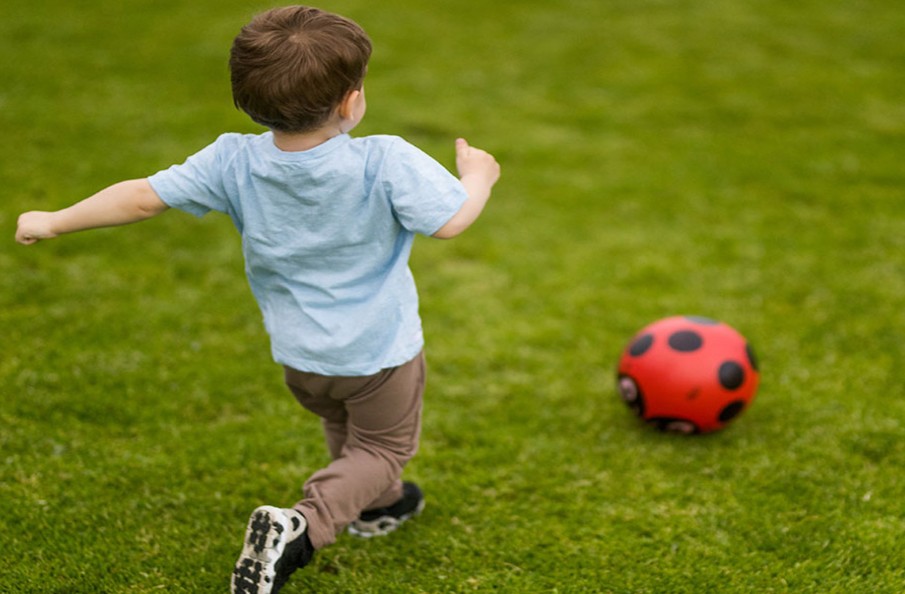
Not a big takeover really, but it’s good to have it confirmed. Activity is also good for children!
Children are less physically active than they used to be.
Globally, children are less active than before, and this can have lasting consequences for your health. This inactivity comes at the same time as obesity rates are increasing – one in ten children and young people are now living with obesity. Increased sedentary time, stress, poorer food quality, and lower participation in sports are all contributing factors.
The good news is that understanding what makes children less active also offers opportunities to encourage them to move more – which will benefit them both now and in the future. In fact, more and more research suggests that there are practical and effective ways to do this, which also strengthen children’s physical and cognitive health.
Read: Stephen Colbert’s secret YouTube channel: 269,000 subscribers on one video
60 minutes a day
According to the recommendations, children should have 60 minutes of physical activity every day. Unfortunately, many people meet this goal.
This can have lasting effects, because physical inactivity in childhood is associated with lower activity levels in adulthood. Children who are more physically active are also more likely to be active as adults.
Sports at school improve health in old age
A long-term study that followed 712 World War II veterans for 50 years found that participation in sports in high school was the strongest predictor of better health at 70 – in addition to being more physically active in older years. Those who played sports also had fewer visits to the doctor.
Numerous studies show similar effects. Exercise in childhood is also linked to better long-term health. Those who participate in youth sports have lower body mass index (BMI), smaller waist circumference, better mental health, better educational performance, and better cognitive performance.
Exercise strengthens the brain
Physical exercise also benefits children here and now,” says Nicole Logan, associate professor of kinesiology at the University of Rhode Island in the US.
“It improves body composition, but it also improves and maintains positive cognitive functions as children develop through adolescence,” she explains.
“The more physical activity we do, the better cardiovascular shape we get – and that’s good for our brains too.
After-school programme improved cognition
Logan and colleagues completed a nine-month training program after school. They found that children with obesity had better cognitive results than those who did not participate in the program. The activities took place after school hours and included moderate to high-intensity activities five days a week.
The intervention was also found to reduce body fat in the children. That’s one of the reasons why my cognition improved,” Logan explains. Fat stored around vital organs can lead to inflammation – which in turn is linked to poorer cognitive function.
Aerobic fitness and physical activity, in turn, have been linked to better accuracy on complex tasks, better reaction time, and improved inhibitory control – which helps children resist impulsive reactions and is therefore key to concentration.
60 minutes of movement in school every day
Logan suggests that schools should introduce 60 minutes of movement per day. This will remove the burden for parents of facilitating sports participation – which can be both costly and time-consuming.
Not just organized sports that count
Increasing physical activity doesn’t have to mean structured sports either. In a study in Massachusetts, USA, increased opportunities for physical activity before, during and after school – combined with better access to healthy food – led to lower BMI among primary school children. About a quarter of these children had not participated in any sports in the year before the study.
“It wasn’t about training, but about sitting less
School-based interventions have also shown promising results. A new study encouraged teachers in 30 UK schools to reduce sedentary time. Among the children who participated, an eight percent decrease was recorded in waist-to-hip ratio (a measure of belly fat) and a ten percent increase in sports participation.
The teachers were encouraged to ask the children to stand up when answering questions, and to move around the classroom more than usual.
“It wasn’t about exercise, but about sitting less,” says Flaminia Ronca from University College London’s sports institute, who is the lead author of the study.
Since children sit for large parts of the school day, creative ways to add movement can improve health,” she says.
Better cognition with just half an hour of activity
It’s unclear whether this type of intervention has long-term effects, but Ronca says that early establishment of healthy habits can provide lasting benefits. In line with other studies, Ronca’s research also suggests that the more active the children were, the faster they responded to cognitive tasks that involved attention and inhibitory control.
Follow-up research found that a single half-hour physical activity session also improved children’s performance on cognitive tasks.
Parental support increases participation
Since physical activity often declines during adolescence – especially for girls – parental support can increase participation. A study in the United States showed that girls whose parents encouraged them and helped them find activity opportunities were more likely to continue playing sports.
Children also learn from the adults around them. Research shows that children are more likely to be physically active if their parents are also active – and especially if their parents exercise with their children. It can be as simple as a bike ride in the local park or a short jog together.
Self-confidence and freedom of choice
Another way to increase physical activity is to look at how children feel when they move.
Michaela James from Swansea University’s Faculty of Medicine in the UK has found that when children feel confident and competent in movement, it increases their well-being. Many schools focus heavily on structured physical activities, which can make some children feel left out – and can negatively affect their self-esteem.
Giving children more choices in what activities they do can be life-changing,” she says.
“It can seem chaotic to hand over power to young people and just say ‘stay tuned’. But I think it plays a huge role in raising kind and compassionate people.
Free play and creative playgrounds
Increasing unstructured play should also be easy to implement: encourage active movement breaks and make sure that recess is not removed as punishment – something that some schools unfortunately use as a behavioural intervention.
Designing playgrounds more creatively to encourage open-ended play – with items such as boxes, decks, or wooden pallets – can also help to increase activity levels.
“All movement is valuable”
And most importantly, we need to recognise that all movement is precious, says James – whether it’s climbing a tree, running around a playground or playing last.
“It’s about valuing what the children themselves want to be able to do,” she concludes.
Club choice after Manchester United gives Christian Eriksen a massive downfall