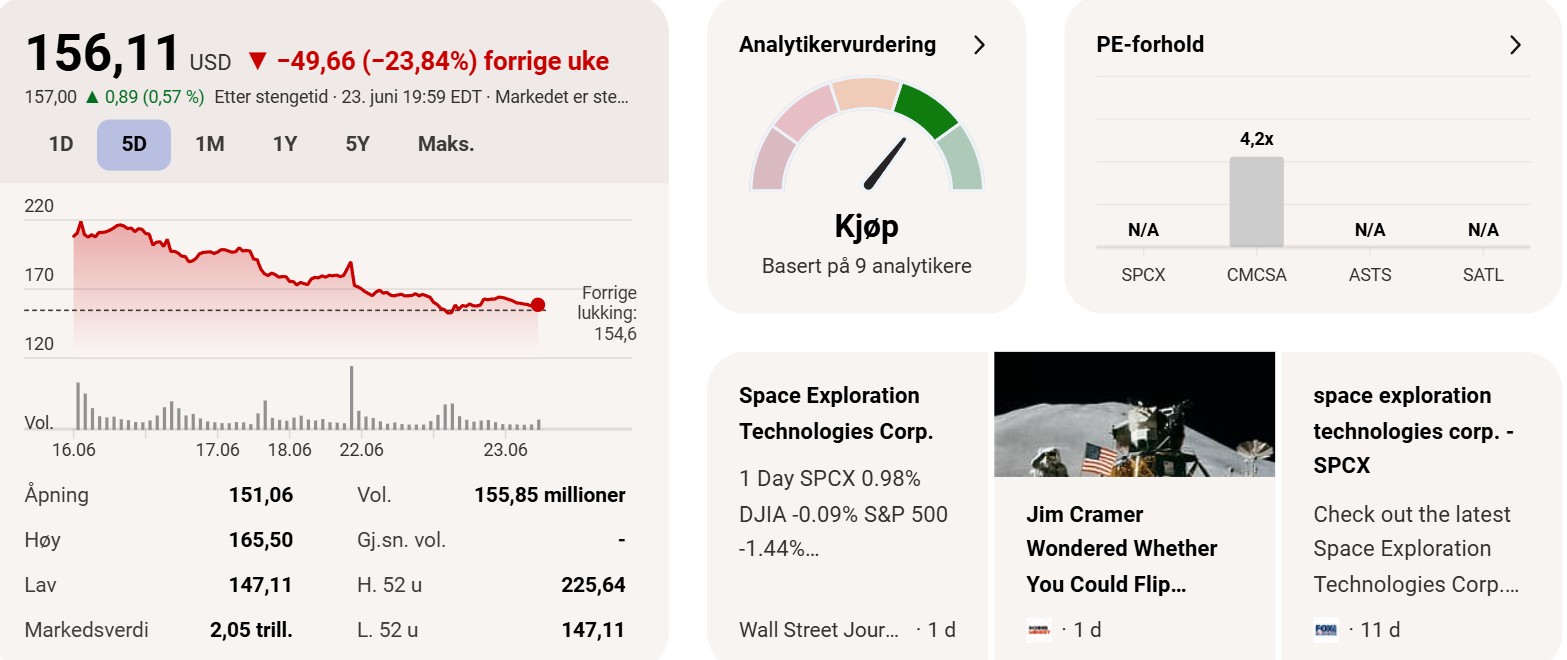
To my great surprise, the vast majority of analysts recommend the SpaceX stock. – A stock that has fallen by over 20% in the last five days, but is still worth over $2 trillion.
SpaceX has completed the largest IPO ever – but behind the staggering numbers hides a picture of overvaluation, serious lawsuits and a fundamental lack of realism. – The plans of the world’s richest man Elon Musk even break the laws of physics by winning send data centers into space.
Read: Robin Hood like you’ve never seen him before
The IPO in numbers – and why they don’t add up
SpaceX has confirmed that shares of the company were priced at $135 per share. The company is selling over 555 million shares and expects to raise $75 billion. This gives the company a valuation of a staggering $1.77 trillion – far more than Saudi Aramco’s record listing and the largest ever. – The whole apparatus has been set in motion to tempt everyone to buy shares, many have been tempted by Elon Musk’s promises that the company will be worth more than $10 trillion in five years. – $10,000,000,000,000 –
If you take the same valuation of other companies based only on turnover and not profit, which is more common, a company like Apple would be worth almost 50 trillion dollars.
The problem? The numbers do not correspond to reality. SpaceX is a company that makes some money, but far from enough to justify such a value. For the investment to pay off, SpaceX needs to increase its revenue 400 times over the next four years (based on $1.77 trillion). It is a promise that lacks any foundation in economic realism.
The ownership structure that hides losses
The most remarkable thing about SpaceX is that the company also owns xAI – an AI company – and that xAI in turn owns Twitter/X. For a rocket company, this is an extraordinarily strange construction.
The explanation is far simpler than one might think: SpaceX is used as a shield to hide huge losses in both xAI and Twitter. By placing the loss-making companies under SpaceX’s umbrella, the risk is transferred from the unprofitable entities to a company that actually generates revenue.
The result is that SpaceX shareholders now indirectly own two companies that are bleeding money – without this being clearly communicated to investors.
Serious lawsuits: Cruelty, abuse material and deepfake images of minors
SpaceX’s new shareholders don’t just inherit a company with artificially inflated numbers. They also inherit a number of serious lawsuits.
Several teenage girls in California have sued Elon Musk for allowing users to manipulate photos and videos of them to generate nude photos and sexualized content – without their consent. The lawyers for the girls claim that the AI chatbot Grok was developed with this feature to increase the use of the chatbot and of Musk’s social network X.
This is far from the first time. Grok has also been revealed to have generated child abuse material. Elon Musk was reportedly warned about the problems, but chose to dismiss the concerns and fired employees who raised the matter internally.
For SpaceX shareholders, this means a potential legal risk. With SpaceX now owning xAI and X, the company will be tenable for lawsuits related to Grok’s illegal content. This is a risk that investors have not necessarily taken into account.
Overestimation and unrealistic goals
Several sceptics on Wall Street have already begun to question the valuation. They point out that Elon Musk has a history of promising far more than he can deliver. Now he claims that SpaceX will send AI data centers into orbit around the Earth and establish factories on the moon.
The problem is that these goals collide with the laws of physics:
- Data centers in space require enormous amounts of energy – which in practice means massive solar panels that have to be transported up into orbit. The costs are astronomical.
- Data centers also produce enormous amounts of heat – the equivalent of an atomic bomb. In space, it is extremely difficult to get rid of heat, and radiators of sufficient size would weigh tens of thousands of tons.
- Carrying all of this into space would be the most expensive project humanity has ever attempted – many hundreds of times more expensive than everything else combined.
Experts agree: This is not only unrealistic, it is physically impossible. Musk knows this, but still uses the promises as marketing to attract investors.
Elon Musk’s role – and the dangers for investors
Musk has always lived on hype and exaggerations. It has often worked, because investors have let themselves be carried away by the visions. But this time, the stakes are far higher.
The criticism of Musk is about three factors:
- Overpromising – he promises things that cannot possibly be delivered.
- Prioritizing attention over security – The Grok case is a clear example of how he has chosen to ignore warnings in order to increase the use of the services.
- Opaque corporate structures – the losses in xAI and X are hidden behind SpaceX’s success.
For new shareholders, this means that they are not just buying into a space company. They buy into a conglomerate of unprofitable entities and potential lawsuits – all wrapped up in a glossy image of space adventures.
What now for SpaceX shareholders?
SpaceX’s IPO is one of the most bloated projects in modern times. It is based on unrealistic promises, hidden losses and serious legal problems.
Investors who jump on this wave risk being left with huge losses when reality catches up with the hype. The laws of physics cannot be negotiated away, and the lawsuits do not disappear by themselves.
SpaceX may be an impressive tech company, but its $1.77 trillion value is a pure illusion – created by an entrepreneur who has always had a knack for selling dreams, but has rarely delivered on the biggest promises.
The question is not if the bubble will burst, but when.
Elon Musk’s SpaceX completed the largest IPO in history – but at what price for ordinary people’s pensions?
To put it in perspective: SpaceX is now worth more than all U.S. defense contractors combined. The company is worth more than the market capitalizations of Coca-Cola, McDonald’s, Disney, Nike, and Starbucks combined. And it is worth more than the ten largest companies on the London Stock Exchange combined.
But here comes the big question: Who on earth buys a company that loses $5 billion a year – for the largest IPO in history?
The answer, according to several sources, is you.
How the rug cover works
Let me explain this in a way that is easy to digest – because financial news can often be difficult to follow.
At the time of the IPO, SpaceX went from being a private company to becoming a company that is listed on the stock market. This means that retail investors can now trade the shares on the stock market. It sounds normal and okay – except that the way this happened was a little different. And that way bypassed certain regulations that many believe are necessary.
You probably know SpaceX from their rocket launches, but the company also includes Starlink and Elon Musk’s AI model xAI. Last year, these three companies reported a combined loss of $5 billion on revenue of $18.5 billion.
The indices gave up investor protection
According to The New York Times, SpaceX convinced the major stock market indices to effectively give up their investor protections. Sounds like a good idea? To give up safety measures when it comes to something that could affect millions of people?
Traditionally, indices like the NASDAQ do not include companies until one year after their IPO. So they wait a year. But in this case, that did not happen. SpaceX asked the indices to speed up the process on their behalf – and they obliged. They listened. They obeyed.
Now, the NASDAQ, among other indices, lists companies like SpaceX just one week after the IPO. A major security mechanism has in practice been thrown out of the window.
Your pension money is the starting liquidity
The changes mean that a large portion of the index funds – which millions of people own in their pension funds, pension plans and personal portfolios – are now ready to hold SpaceX shares shortly after the company went public.
And SpaceX has apparently admitted the plan. While most IPOs allocate 5 to 10 percent of the supply to retail investors, SpaceX targeted a whopping 30 percent.
Brett Johnson, CFO of SpaceX, told a room full of bankers—on recording—that “retail is going to be a critical part of the IPO and bigger than any IPO in history.” His reasoning? “Retail has been incredibly supportive for us and for Elon for a long time, and we want to make sure we recognize that.”
Translated from corporate jargon: The CFO of SpaceX told a room full of bankers that the largest IPO in history is going to dump 30 percent of its offering on ordinary people – not because they help with price stability or long-term shareholder adjustment, but because they are loyal to Elon.
The buyers and sellers do not show up at the same time
This is how the story unfolds: The buyers of SpaceX are forced in early. The sellers will be unlocked later. Stocks are moving from insiders – who sit on a low-cost base – to passive funds and retail investors, whose retirement accounts absorb them to peak value.
Portfolio manager George Noble said it best: “Your 401(k) is the exit liquidity.”
This is bigger than SpaceX
This is about more than just SpaceX. The new rules – or rather the lack of rules – are called fast-track rules. They will soon apply to other AI models such as OpenAI and Anthropic, which are also expected to go public very soon.
The NASDAQ has both denied the finest details of this story, while also admitting the overarching premise. NASDAQ President Nelson Griggs said in a Bloomberg interview in May that the exchange had begun discussing changes to the index rules more than a year ago. Since SpaceX, Anthropic, and OpenAI were so big, he said, it was important that index fund investors didn’t have to wait to access them.
The S&P 500, on the other hand, has stood firm and promised not to let SpaceX enter the index until at least a year has passed. It is probably the right thing to do.
A disaster for ordinary people?
This is the type of information that can potentially influence your investment decisions. Many believe this is a disaster.
To be honest: The vast majority of Americans don’t even have the money to participate in the stock market or save for retirement. That is perhaps the biggest problem.
But if you’re lucky enough to have some wealth, many Americans just contribute money to their retirement account – and don’t really think about it anymore after that. They don’t constantly look at it or change what their investments are. They are on cruise control.
And these rule changes can certainly ruin their portfolio – without them having any idea.
The big picture: Increasing inequality
The bigger point is that this ties in with what has led to enormous wealth inequality in this country: a concentration of all wealth at the top, while the rest of us suffer. This is deregulation. A form of deregulation that will make Elon Musk a trillionaire.
The real question is: Who is left with the bill?
The figures in this article are based on reporting from The New York Times, Bloomberg and public stock exchange documents.
All about Sports