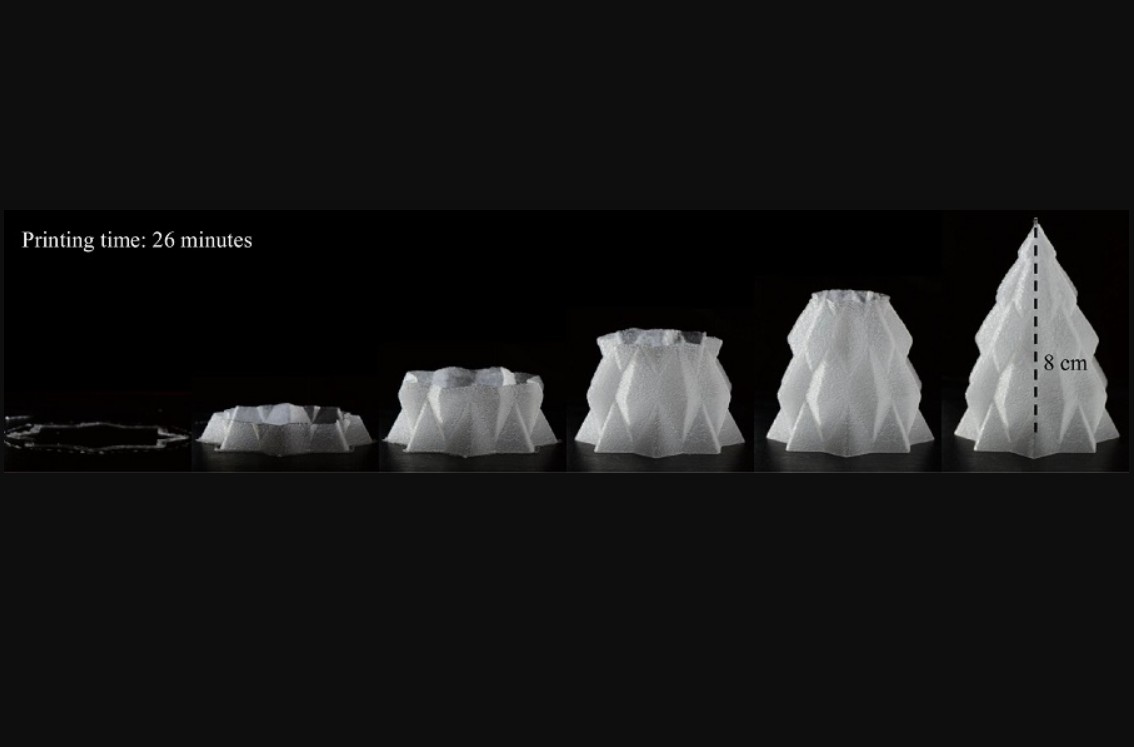
Physicists at the University of Amsterdam have developed a groundbreaking method for printing three-dimensional structures with water and ice. The technique makes it possible to create tiny ice columns at sharp angles – without having to use support materials that are otherwise needed in traditional 3D printing.
How the method works
The secret to this unusual process is evaporative cooling – the same natural mechanism that helps humans and other mammals regulate their body temperature. When sweat evaporates from the skin, it removes heat and makes the skin cooler.
Has found a new, better way to build metal connectors for tomorrow’s computer chips
The researchers apply this principle inside a low-pressure vacuum chamber. Under extremely low pressure, water evaporates very quickly – even when it starts at room temperature. Each water molecule that evaporates takes a small amount of heat with it. As more molecules escape, the water that remains becomes colder – and eventually the temperature drops below zero degrees Celsius.
But the water doesn’t freeze immediately. Instead, it enters a state called subcooling – that is, it remains liquid despite the temperature being below normal freezing.
Prints thinner than a strand of hair
The printer then releases the supercooled water through an extremely thin jet – only about 16 micrometres in diameter, i.e. thinner than a human hair. As soon as the water hits a layer of ice that has already formed, it instantly freezes.
By carefully controlling where the beam hits, the printer builds the ice structure layer by layer.
Physicists Menno Demmenie, Stefan Kooij and Daniel Bonn previously caused a stir by printing a small Christmas tree out of ice using this technique. The tree took 26 minutes to build inside a vacuum chamber with a pressure of two millibars.
From Christmas tree to human face
In their new study, published in the journal Proceedings of the National Academy of Sciences, the researchers show that the method can create far more than simple, straight shapes. By changing the speed of the printer, they can control the direction in which the ice grows.
The team printed narrow ice columns at angles as low as 14 degrees from the surface. They also demonstrated the method by printing the contours of a human face.
The big advantage: Because the ice is strong enough to support its own weight, the inclined parts do not require any support structures. This distinguishes the method from many common 3D printing techniques, where temporary supports are often needed to prevent overhanging parts from collapsing.
Eco-friendly and versatile
The process is also remarkably clean. When the vacuum pump is turned off, the finished object simply melts back into water – leaving no waste behind.
But the method is not just about creating beautiful shapes. The researchers see several practical applications:
- 🧬 Biological tissue cultivation – pure ice structures can be used as scaffolding to grow tissue
- 🔬 Microfluidic devices – ice can form detailed channels that are later melted away
- 🌌 Future Mars colonies – the planet’s cold temperatures and thin atmosphere could provide ideal conditions for printing useful structures from locally available water
The future: Ice on Mars?
The researchers envisage that the technology could one day be used on Mars. With its low temperatures and thin atmosphere, the red planet could offer perfect conditions for ice-printing – with water that already exists locally.