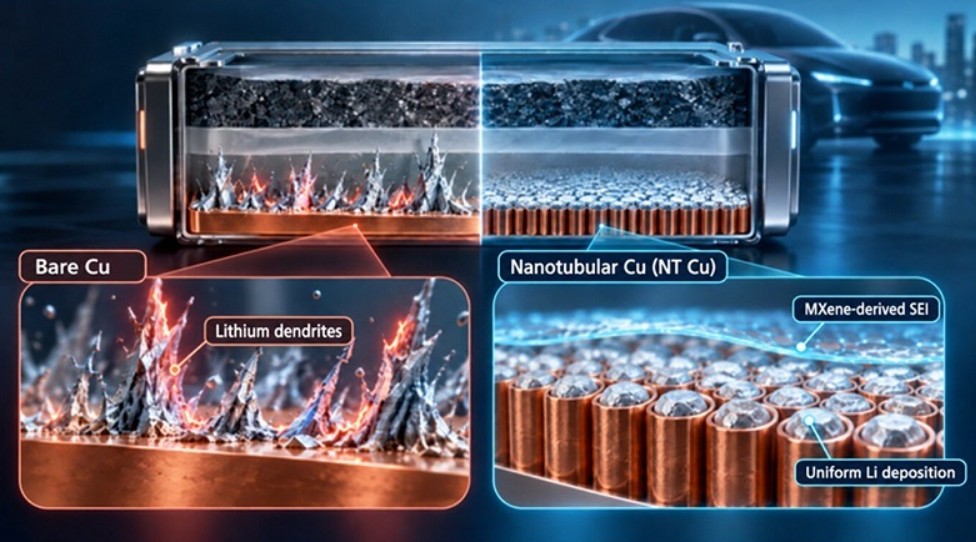
Researchers in South Korea have developed a battery design that can help electric cars drive longer, while making the battery packs smaller and lighter. “The technology solves a major problem that has prevented powerful “anode-free” batteries from lasting long enough for daily use.
The study was led by Professors Jinwoo Lee and Hee-Tae Jung at KAIST, in collaboration with researchers from Kyungpook National University and the National NanoFab Center.
The findings were published in the journal Advanced Functional Materials.
Most lithium-ion batteries contain an anode made of graphite. During charging, lithium moves into the graphite, where it is stored until the battery is put to use.
Anode-free batteries remove this graphite layer. Instead, lithium is deposited directly onto a thin copper foil during charging. Removing graphite saves space and weight, allowing a battery of the same size to store more energy.
This can be especially useful for electric cars. A lighter battery can improve range, while a smaller battery can give car designers greater flexibility.
However, anode-free batteries have a serious weakness. Lithium does not always distribute evenly across the copper surface. It can grow into sharp, branch-like structures called dendrites during repeated charging and discharging.
These structures reduce battery performance and can damage the protective layer around the lithium. The result is that the battery loses capacity and wears out too quickly.
Previous attempts to solve the problem often involved adding extra lithium or applying a thick protective coating over the surface. While these methods can extend the life of the battery, they also make it heavier and larger. It removes much of the advantage of an anode-free design.
The KAIST-led team chose a different approach. Using a manufacturing method also used in the semiconductor industry, the researchers created rows of microscopic tubular structures on the copper foil.
The tubes were about 300 nanometers wide and 150 nanometers high. These tiny structures increased the available surface area to about four times that of ordinary flat copper.
The design works like adding carefully marked parking spaces to an empty parking lot. It gives lithium many evenly spaced places to settle, reducing the chance of it accumulating in one place and growing into dangerous spikes.
The researchers also added an extremely thin coating of the MXs, a two-dimensional material. The coating was only about 10 nanometers thick – or thousands of times thinner than a human hair.
The MXs don’t act as the final layer of protection. Instead, it acts more like a primer, encouraging the battery to form its own strong and even protective layer rich in lithium fluoride.
This protective layer reduces unwanted chemical reactions and further limits sharp lithium growth. Detailed imaging and chemical tests confirmed that it formed evenly along the treated surface.
Professor Lee says the study shows that highly precise semiconductor manufacturing methods can control where lithium is deposited, without adding excess lithium or changing the main battery fluid.
The results are promising, but the technology will still need testing on a larger scale in real-world driving conditions. If it continues to perform well, it could bring lighter, longer-lasting anode-free batteries closer to commercial EVs.
Popidol: Nolan’s The Odyssey shatters Universal’s record for highest-grossing film