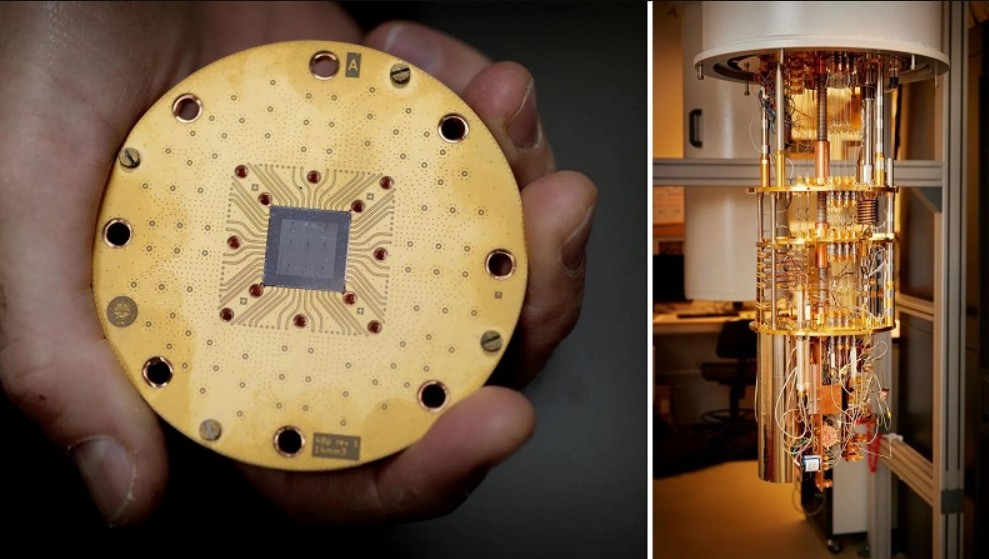
Quantum computers promise to solve some problems that are extremely difficult for today’s computers.
But there is a major obstacle: quantum information is very fragile, and even tiny disturbances can cause a calculation to go wrong.
Researchers at Chalmers University of Technology in Sweden have now proposed a way to perform a wide range of advanced quantum operations more than 1000 times faster than some previous methods. By completing the operations much faster, the approach can reduce the time errors have to build up.
Camp Nou will be the venue for the Champions League final
The theoretical study was published in Physical Review Letters under the title “Single-Period Floquet Control of Bosonic Codes with Quantum Lattice Gates”. The authors are Tangyou Huang, Lei Du and Lingzhen Guo, who are affiliated with Chalmers University of Technology and Tianjin University.
Ordinary computers store information as bits, which normally have a value of 0 or 1. Quantum computers use quantum bits, or qubits, which can behave in more complex ways and make it possible to attack certain computations completely differently.
This unusual behavior could eventually help with problems in areas such as chemistry, drug development, energy technology, logistics, and materials science. But useful large-scale quantum computers will have to keep errors under control through long and complicated calculations.
This is difficult, because qubits are extremely sensitive. Electrical noise, unwanted heat, radiation, and other small changes in their surroundings can disrupt their quantum state and damage the information being processed.
The researchers are therefore developing quantum error correction. The basic goal is to protect important information so that errors can be detected and corrected before they ruin an entire calculation.
The Chalmers team studied an approach known as bosonic quantum codes. Instead of storing quantum information only in individual qubits, these codes can place information in controlled microwave fields inside superconducting circuits.
This method can provide built-in protection against certain types of errors. However, creating and controlling the complicated quantum states needed for these codes has itself been slow and difficult.
Previous methods may require thousands of repeated control cycles to produce a desired operation. Each additional cycle takes time, and longer operations provide environmental disturbances with more opportunities to disrupt quantum information.
The researchers developed a shortcut based on what they call quantum lattice gates. These gates are basic control tools designed to perform a wide range of operations on bosonic quantum states.
With the new method, operations that previously could require several thousand drive cycles can be completed within a single cycle. For some tasks, this represents a speed increase of more than 1000 times.
The researcher Lei Du explained that faster operations are not just about getting a quantum computer to complete a calculation earlier. Reducing the length of an operation can also lower the chance of outside interference destroying the information before the operation is complete.
Co-author Tangyou Huang compared the idea to building a large Lego castle. Instead of placing each brick individually, the new gates are more like ready-made sections that can be quickly put together, reducing the number of steps required.
The technique uses carefully designed, repetitive control signals to control the quantum system. Previous approaches based on similar repetitive signals generally needed many cycles, while the new design allows the intended gate to be produced directly in one cycle.
Another advantage is that the proposal is designed for superconducting quantum circuits. Superconducting systems are already widely used in quantum computing research, so the method may be compatible with technology laboratories are developing today.
Chalmers itself is working on superconducting quantum computing, including work on a 100-qubit machine. The researchers say they are discussing possible experimental tests of the new technique with colleagues.
The experimental step will be important. The current work is theoretical, which means that the researchers have shown through mathematical and computer-based analysis how the method should work, but it still needs to be demonstrated in real quantum goods.
If experiments confirm the predicted speed and control, the approach could solve an important bottleneck in quantum computing. Rapid preparation and control of fault-protected quantum states will be crucial if future machines are to be able to perform long calculations reliably.
The study does not mean that fault-tolerant quantum computers are now ready. Many engineering and scientific challenges remain, including improving hardware, reducing various types of failures, and scaling systems to much greater numbers of reliable quantum components.
Still, the research provides a possible way to make one important part of quantum computing dramatically faster. By shortening complicated operations from thousands of control cycles to one, the method can help scientists build quantum systems that have less time to make mistakes.
Read on TimePeopleWorld: Avengers: Doomsday Breaks Barrier — Historic pre-sale record shocks the industry