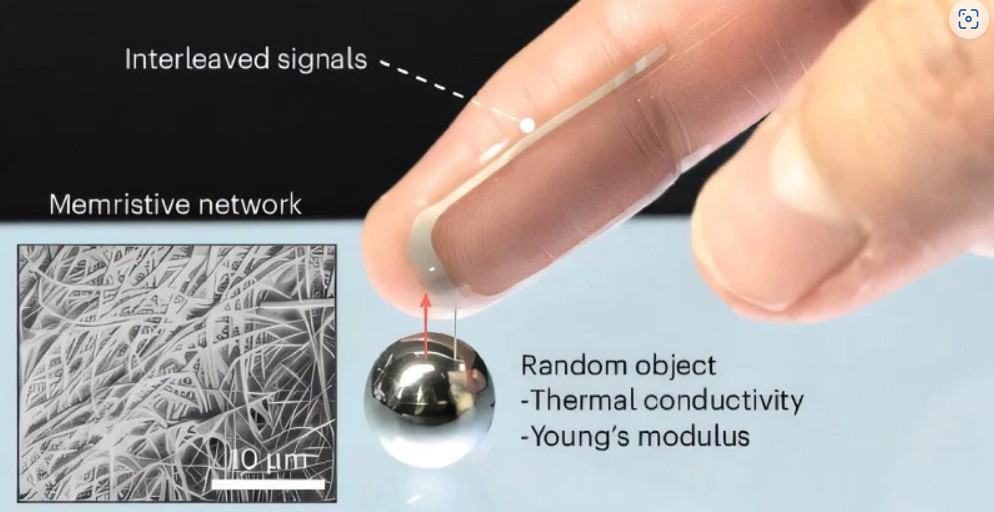
Researchers have developed a new type of artificial skin that allows robots to feel both temperature and pressure at the same time – just like human skin. The breakthrough could pave the way for smarter robots that interact with people and their surroundings in a far more natural way.
The research is led by Professor Seung Hwan Ko and his team at Seoul National University in South Korea, and the findings have been published in the journal Nature Materials.
Human skin is a wonderful sensory organ. It quickly distinguishes between hot and cold, hard and soft, smooth and rough – and combines all the information almost instantly. This ability helps us to react confidently and make quick decisions. Giving robots the same ability has long been a major challenge for researchers.
Read: Do you want to live longer? Researchers believe that two hours of strength training a week may be enough
Most existing robotic systems use several different sensors stacked on top of each other – one for pressure, one for temperature, and others for different types of touch. While this works, it makes the device thicker, more complex, slower, and harder to manufacture. It can also reduce accuracy when different senses are to be perceived in exactly the same place.
One sensor – two senses
To solve these problems, the research team created a single, ultra-thin sensor that can switch between measuring temperature and pressure. Instead of multiple layers, everything is built into one flexible unit.
The sensor consists of a small network of nanowires with a silver core surrounded by a copper oxide shell. The special design allows the sensor to switch between temperature and pressure modes as much as 16 times per second.
Because the sensor is so thin, it reacts extremely quickly. It can detect pressure in less than one microsecond – and temperature changes in milliseconds. This rapid response is crucial for robots that need to react immediately when handling objects or working with humans.
The researchers connected the sensor to a wireless electronics board and artificial intelligence. The AI learned to recognize different objects by analyzing both temperature and pressure information at the same time.
When the AI only used temperature or only pressure data, it was able to identify objects with about 65 percent accuracy. But when both types of information were combined, the accuracy jumped to 95 percent — even when the amount of data was reduced, the system maintained an impressive accuracy rate of over 94 percent.
Works outside the lab
The team also tested the technology with a fingertip-sized sensor attached to a wireless device. In this experiment, the system identified 20 common everyday objects with 83 percent accuracy – clear proof that the technology works in real-life situations.
The researchers then expanded the design to a larger sensor field that can measure both pressure and temperature across a surface. The solution resembles human skin – suggesting that the robots of the future may one day have artificial skin over large parts of their bodies.
From robotics to prosthetics
The technology can have many practical applications beyond robotics. It can improve dentures by giving users a better sense of touch. It can also be used in wearable electronic skin, soft robots, robotic hands that can gently grip fragile objects – and advanced human-machine interfaces.
Professor Ko says that the study is the first to show that both temperature and pressure can be measured in a single ultra-thin unit – without stacking multiple sensors. He believes the technology can become a key building block for the robots of the future – robots that can feel and react to their surroundings almost as naturally as humans.
Hafþór “The Mountain” Björnsson’s little wife answers the question everyone always asks her