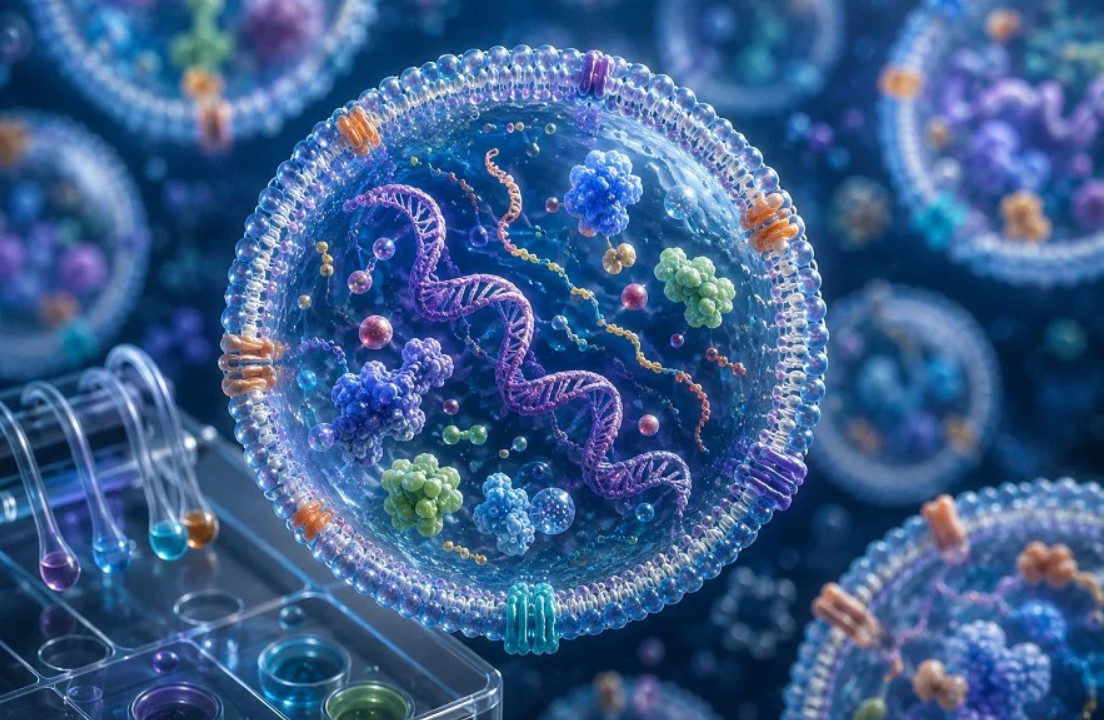
A team of researchers from across Asia has launched an ambitious project to create artificial living cells from non-living materials over the next decade.
If successful, the effort could transform biology, medicine, and biotechnology while helping scientists answer one of humanity’s biggest questions: What is life?
Read: New solar-powered desalination system can produce drinking water without harmful waste
The project is led by researchers from the Shenzhen Institute of Advanced Technology of the Chinese Academy of Sciences and involves more than 100 researchers from China, Japan, South Korea, Singapore, Thailand and Malaysia.
Their roadmap for achieving this goal was recently published in Nature Biotechnology.
The researchers are working towards a remarkable challenge: to build a synthetic cell entirely of basic biological components such as fats, proteins, DNA and other molecules.
Unlike existing living cells, which evolved naturally over billions of years, these cells were assembled from scratch in the laboratory.
Scientists believe that creating a fully functional artificial cell will provide valuable insights into how life works at its most basic level.
It can also open the door for specially designed cells that perform specific tasks, such as producing drugs, producing useful chemicals, or helping to treat diseases.
Although researchers in Europe and the United States have been conducting research on synthetic cells for decades, building a complete artificial cell remains a major challenge.
Scientists have succeeded in creating individual components and biological systems, but combining them into a single cell that functions as a living organism has proven far more difficult.
To meet this challenge, the participating Asian countries formed SynCell Asia Initiative in 2023. Through a series of workshops, they developed a common strategy that combines expertise from several disciplines and countries.
The roadmap identifies four major scientific obstacles.
Scientists must ensure that synthetic cells can continuously generate energy and essential molecules, produce their own ribosomes—the structures that form proteins—follow reliable design rules, and coordinate many biological processes in the right place and time.
To support collaboration, the initiative proposes a centralized system in which standard synthetic cell components are manufactured and distributed to participating laboratories. The researchers will then test, improve, and redesign the cells through a continuous cycle of experimentation and learning.
Advanced technologies will play an important role. Scientists plan to gather detailed information about synthetic cells, including their genes, proteins, metabolites, and internal structures. Artificial intelligence and machine learning will then help scientists understand and predict how the cells behave.
The roadmap is divided into two phases. During the first five years, the researchers aim to create a “ProtoCell” – a simple synthetic cell enclosed by a membrane and with a minimal genome of at least 200 genes. Most of the proteins would be produced by a laboratory-based protein production system, while the cell would also produce some of its own essential molecules.
In the second phase, from years six to ten, the researchers hope to create an “AutoCell.” This more advanced synthetic cell would produce its own ribosomes and become capable of true self-replication. The goal is for these cells to grow, divide, adapt to the environment, and even form communities that collaborate by exchanging materials and sharing tasks.
The researchers believe this collaboration could transform synthetic biology from a collection of separate experiments into a coordinated international project, bringing humanity closer than ever to creating lifelike cells from scratch.
Read on The Health Manager: Vitamin D3 better than vitamin D2 for most people