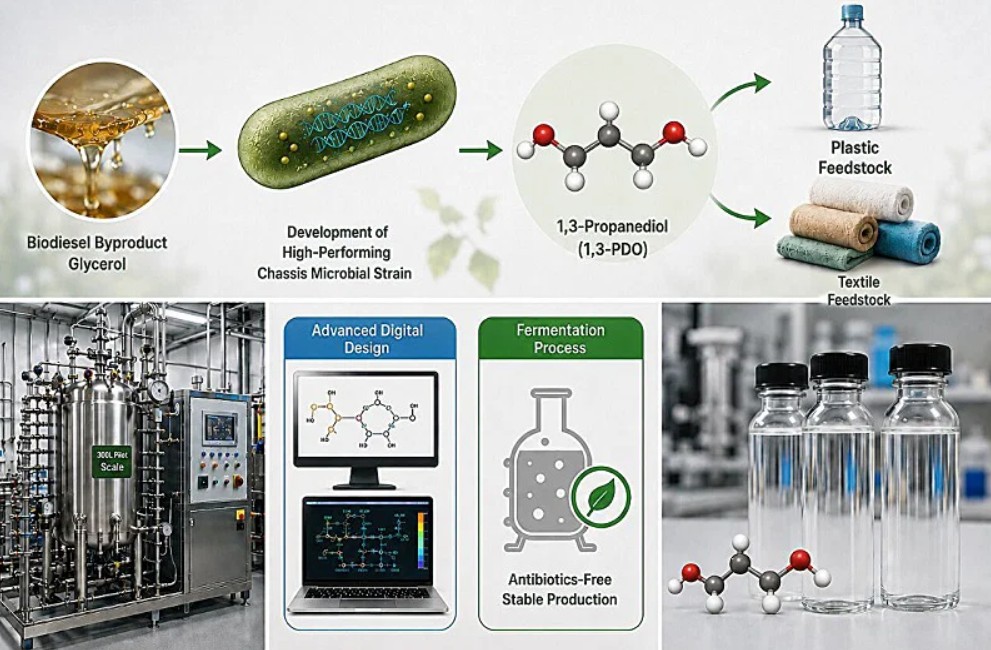
Researchers in South Korea have developed a new biotechnology that uses genetically modified microbes to convert waste from biodiesel production into a key ingredient used in plastics, textiles and cosmetics.
The breakthrough could help reduce reliance on petroleum-based chemicals, while also recycling industrial waste that would otherwise be discarded.
Read: World Cup trouble! The disaster no one talks about
The research was led by researchers at KAIST in collaboration with Hanwha Solutions. Their findings were published in the journal Nature Chemical Engineering.
The addiction to naphtha
Today’s petrochemical industry relies heavily on naphtha, a petroleum-based raw material used to produce plastics, synthetic fibers, and many other everyday products. However, rising prices and unstable supply have increased interest in cleaner and more reliable alternatives.
Waste becomes value
The new technology focuses on glycerol, a waste product created during biodiesel production. Large amounts of glycerol are produced worldwide, and much of it has limited economic value.
Instead of treating it as waste, the researchers designed microorganisms that can convert glycerol into a valuable chemical called 1,3-propanediol (1,3-PDO). This substance is widely used in products such as plastics, cosmetics, coatings, and textiles.
Genetic modification and computer simulations
To make the process work efficiently, the researchers genetically modified microbes so that they produce larger amounts of 1,3-PDO. They also used computer simulations to predict which genes should be modified to improve their ability to reproduce.
From laboratory to large-scale
One of the greatest achievements of the study was to scale the process out of the laboratory. The team demonstrated stable production in a 300 litre fermentation pilot system – an important step towards future industrial production.
Scaling biotechnology from small laboratory experiments to large industrial systems is often very difficult, because microorganisms can behave differently during large-scale production. The fact that they maintained solid performance at the 300-litre level suggests that the technology could eventually be used in commercial production facilities.
Without antibiotics
The researchers also removed the need for antibiotics during the fermentation process. In many industrial microbial systems, antibiotics are used to maintain genetic stability. However, the use of antibiotics can raise concerns related to antibiotic resistance and regulatory approvals – especially for products used in the food, cosmetics or healthcare industries.
By avoiding antibiotics, the process becomes safer and potentially easier to commercialize.
Ten years of collaboration
The project is the result of a ten-year collaboration between KAIST and Hanwha Solutions, which started in 2015. Over the years, the collaboration has led to several scientific articles and patent applications, and it is considered an example of successful cooperation between university and industry in South Korea.
A more sustainable chemical industry
The researchers believe that the work shows that microbe-based chemical production can move out of the laboratory and become a real industrial solution. The technology can help create a more sustainable chemical industry by reducing reliance on fossil fuels, reducing waste, and producing materials in a more environmentally friendly way.
The researchers also believe that similar approaches could eventually be used to produce many other chemicals and materials that are currently made from petroleum.
As industry looks for greener production methods, genetically modified microbes may play an increasingly important role in turning waste into valuable resources.
Read on The Chief Health Officer: 1.2 billion people worldwide have mental disorders