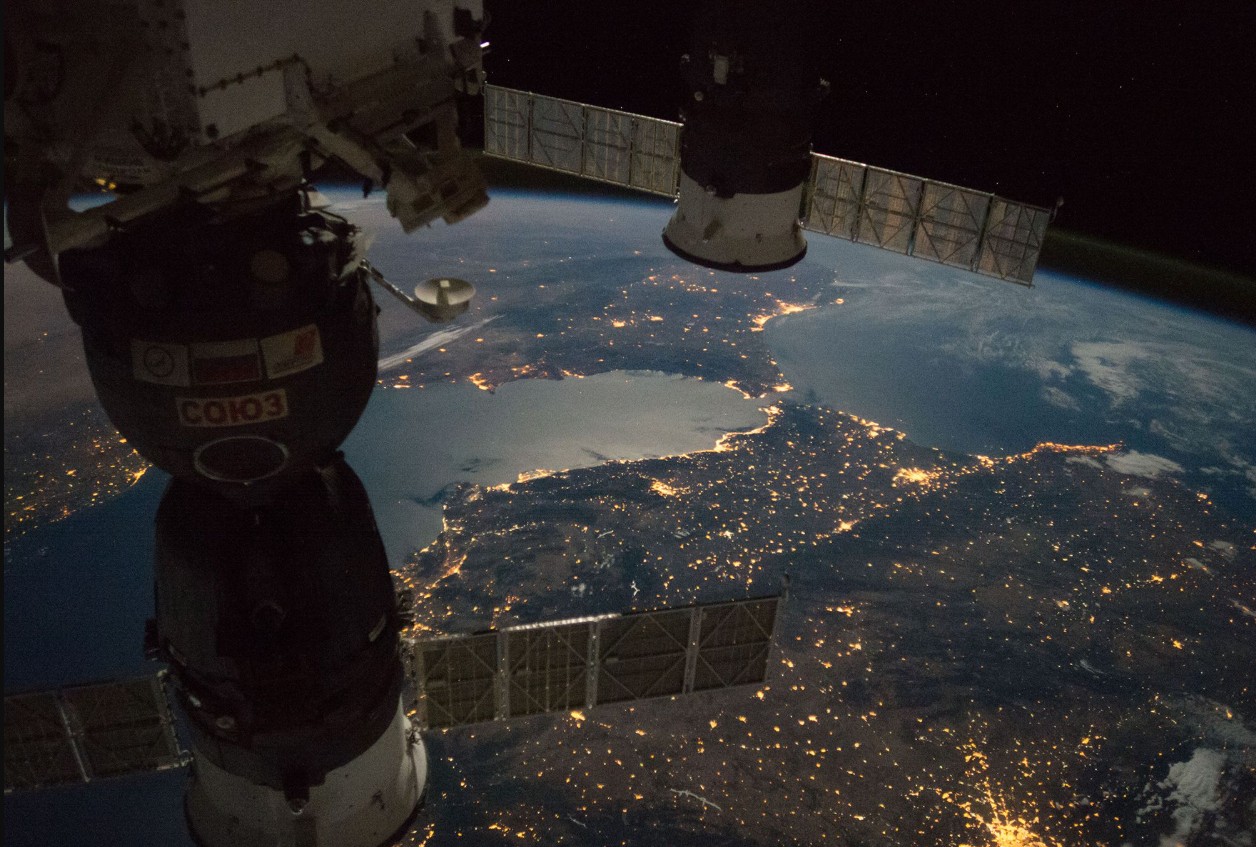
Four people have recently been in orbit around the moon. Their vessel, an Artemis capsule, was a thin metal shell with a life-sustaining system that kept them alive: a carefully balanced atmosphere, an enclosed water system, a limited supply of food, and a way to dispose of waste. Life support was not optional. It was a necessity.
Consider: Not once in the history of space travel has an astronaut tampered with his life support system. No one has released oxygen for fun. No one has argued for a personal right to increase their CO₂ emissions. Sabotage is unthinkable – socially unacceptable. The other astronauts and ground control would intervene immediately.
Read: How can this small world have an atmosphere? Researchers are speechless
Now look at the earth. We are doing with the planet’s life support what no astronaut has done with theirs. We are damaging it – emitting carbon, acidifying the oceans, removing topsoil, and degrading biodiversity – not maliciously, but with a shrug. It’s legal. It is profitable. And in most circles, it is completely socially accepted.
“We choose what is simple and close”
The Victorian writer George Eliot would have understood why. In Middlemarch , she showed us a city that preferred a satisfying, simple myth to difficult and complex truths. People, she argued, do not naturally reach for the truth. We reach for what is close, simple and emotionally rewarding.
Climate science is the antimyth. It is delayed, diffuse, impersonal and global. It asks us to change our behavior today for a benefit that will come decades in the future—somewhere else on earth—for people we will never meet.
The psychological distance is a serious challenge for a brain that has evolved to react to a sound in the grass, not to a graph showing increasing amounts of CO₂ in the atmosphere.
The dragons that prevent action
The myths that allow us to ignore the truth are well-known:
- “If I recycle, I do mine.” “This is insufficient, but feels good.
- “Technology will save us before it’s too late.” “Reassuring, but unlikely, and it postpones action.
- “It’s already too late, so nothing matters.” – Fatalism as an absolution (forgiveness).
- “We will adapt.” “The laws of nature set fixed limits.
The stories are fake, but they are functional. Psychologists call them the “dragons of action”—the mental barriers that allow us to know the truth without feeling its full weight. Along with denial (knowing something but ignoring it), they allow us to continue flying, driving, consuming, and investing – without the discomfort of cognitive dissonance (the stress of holding conflicting beliefs at the same time).
“The earth is a vessel, not an endless resource”
The Artemis crew lives by a different story. They are guided by a simple, undeniable truth: They are in a small, fragile vessel. Life support is absolutely necessary. Damaging it is not an option.
The Earth is also a vessel. It’s just bigger, the support systems are less visible, and the consequences of damage come later. As the economist Kenneth Boulding argued 60 years ago: We must learn to see our planet as a closed system – not an open border.
What narrative can protect the Earth the way we protect astronauts?
Not a political report. Not a carbon tax (although we need them). A story. We already have candidates. No one is perfect, but each one is more powerful than the cold, scientific facts.
One pane of glass: Earth is not a planet we live on. It is a pressurized cabin with a single, irreplaceable window. Every ton of CO₂ puts a new scratch in that glass. You wouldn’t be hammering on the window of the Artemis capsule. Why do it here?
The Blood of Biology: The story of the “blood of the body” depicts the biosphere not as “nature”, but as humanity’s collective and extensive organ system. Cutting down the Amazon and burning oil is not business as usual – it is self-inflicted damage.
The crew of the damned: You are not a consumer. You are a temporary tenant on a multi-generational journey. Nature and the previous shift built the vessel. The next shift will inherit it. To degrade the earth’s systems is to desecrate the ancestors and curse the children. It is not a crime. It is a sin that will outlive your name.
“None of these stories work as mere metaphors”
They only become common sense when they are enforced visibly, socially and economically – when a director opening a new coal mine is met with the same universal horror as an astronaut reaching for the oxygen valve.
Imagine that all human decisions – personal, professional, political – are tested against a single question: If we were in a capsule orbiting the moon, would this be a safe use of our common life support?
If this is repeated often enough, the correct conclusion would become a habit. For those who resist, the rest of the crew would intervene. On Earth, there is no ground control – only us.
Read on The Chief Health Officer: New Barbie doll will help normalize medical equipment for children